
You're commuting east on Highway 401 when the transmission begins to shudder. You take the next exit, the vehicle loses drive, and the repair estimate lands at several thousand dollars. The factory warranty ended recently, so the extended warranty coverage you bought at the dealership suddenly feels like either a financial lifeline or an expensive piece of paperwork.
Whitby drivers face the same practical pressures as anyone who depends on a vehicle every day, with added exposure to salt-heavy winters, stop-and-go traffic on Brock Street, and long commutes toward Toronto. Those conditions can place extra demands on powertrains, suspension components, braking systems, and vehicle electronics. A service contract can help with a major failure, but only when the failed component, repair process, documentation, and authorization rules all line up.

Ontario consumer law provides baseline protections, but extended warranty coverage operates through a separate contract with its own conditions. Before you pay for one, you need to know what the plan covers, who stands behind it, and what you'll have to prove when something fails. A properly maintained vehicle maintenance log can become just as important as the contract itself. If corrosion protection is also part of your ownership plan, reviewing an aftermarket rust proofing warranty can help you distinguish body protection from mechanical coverage.
Why Extended Warranty Coverage Matters for Whitby Drivers
A vehicle failure rarely happens at a convenient time. The transmission doesn't wait until you're parked at home with your paperwork organised. It can fail during a morning commute, while you're merging into traffic, or after weeks of warning signs that were easy to dismiss.
That's why extended warranty coverage appeals to drivers who plan to keep a vehicle beyond its manufacturer-backed warranty. A large engine, transmission, hybrid system, or electronics repair can disrupt a household budget. Coverage may transfer some of that repair risk to a provider, but it doesn't eliminate the need for careful diagnosis or contract compliance.
Whitby driving adds familiar wear patterns. Winter salt can accelerate corrosion around underbody components and electrical connections. Repeated short trips and congestion can work brakes, cooling systems, transmissions, and suspension parts harder than steady highway driving. A longer commute to Toronto also means more kilometres, more operating hours, and more opportunities for a marginal component to fail.
The plan only helps when the failure fits
Ontario treats an extended warranty on a motor vehicle as a separate contract covering repair or replacement of vehicle components, including labour, beyond the manufacturer's warranty or a warranty implied by law. Ontario Regulation 333/08 also restricts registered motor vehicle dealers from selling or facilitating an extended warranty unless performance is insured by a licensed insurer or supported by an irrevocable letter of credit lodged with the Motor Vehicle Dealers Compensation Fund. The required letter of credit is $100,000 when the selling dealer is also the vehicle seller, and $500,000 in other cases. Ontario Regulation 333/08 sets out those requirements.
That legal safeguard doesn't mean every claim will be paid. The policy may exclude the exact seal, sensor, wiring section, software-related fault, or consequential damage involved in your breakdown. It may also require maintenance records, prior authorization, an approved repair facility, or a specific diagnostic procedure.
Practical rule: Treat the contract's claim instructions as seriously as the coverage list. A covered component can still become a denied claim if the process wasn't followed.
The right question isn't just, “Do I want peace of mind?” Ask whether the plan protects you from a repair risk you couldn't comfortably absorb, and whether you're willing to preserve the records and follow the authorization process. The sections ahead focus on those decisions, especially the claim details that sales presentations often skip.
What Extended Warranty Coverage Actually Means in Ontario
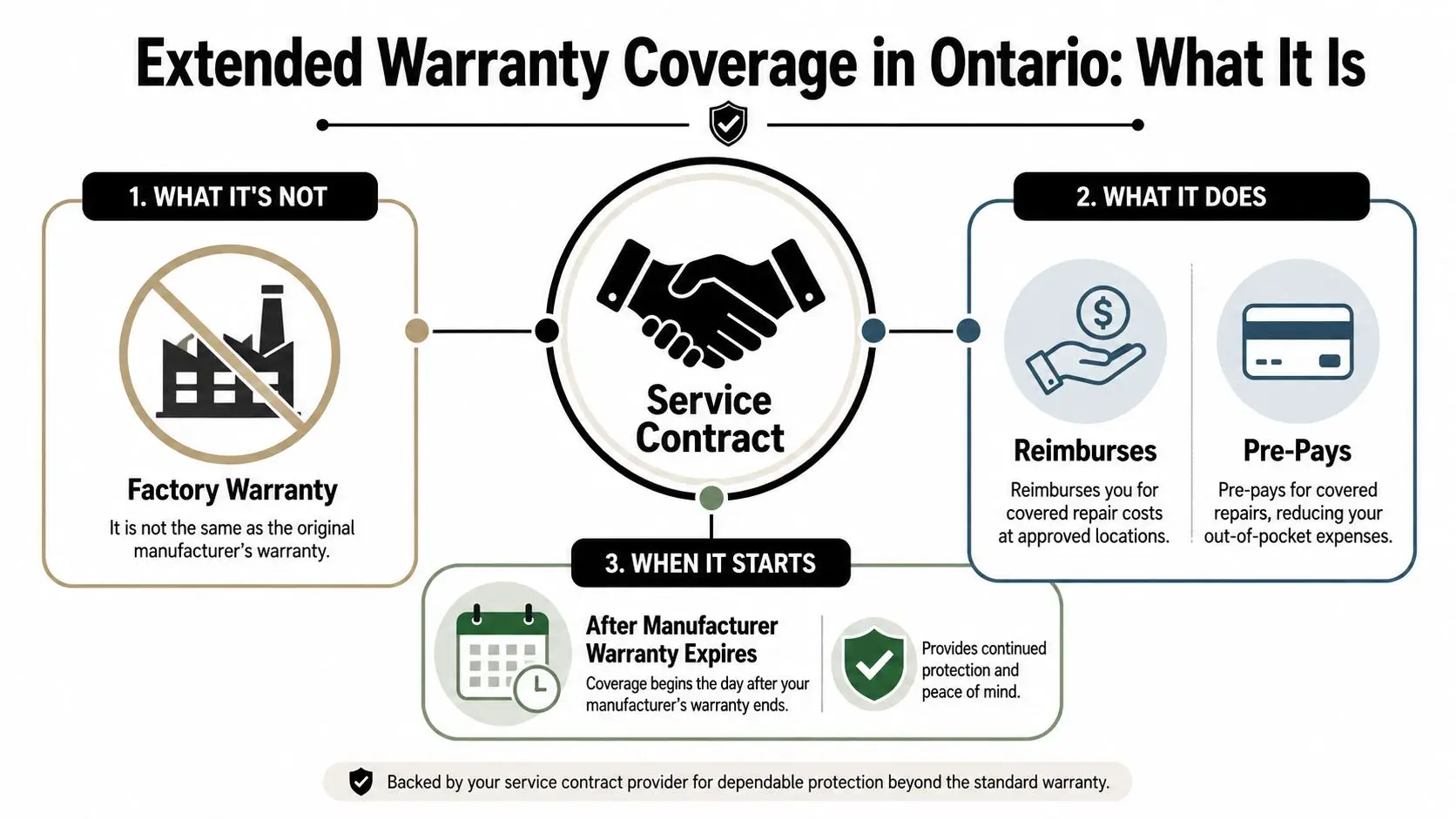
Extended warranty coverage is usually a paid service contract. It promises to pay for, reimburse, or arrange specified repairs after the original manufacturer or merchant warranty no longer applies. The contract may cover parts and labour, but only for listed components or under the terms of an exclusionary agreement.
That differs from a factory warranty. The manufacturer created and backs the original product warranty, while an extended plan may be administered by a dealer, manufacturer, insurer, lender, or independent provider. The administrator reviews the claim, decides whether the contract applies, and controls the authorization process. Those roles matter because the organisation selling the plan may not be the organisation deciding whether your repair qualifies.
Ontario law also recognises consumer protections that exist apart from a paid service contract. A vehicle can carry implied legal warranties relating to merchantability and fitness, depending on the circumstances of the transaction. An extended plan doesn't erase those rights, and those rights shouldn't be treated as a substitute for coverage you're paying to add.
Read the contract, not the sales label
The term “bumper-to-bumper” can sound broad, but the actual agreement controls. One plan may list covered components and exclude everything else. Another may cover a wide range of failures while excluding wear, maintenance, corrosion, or damage caused by an uncovered part. A deductible can apply each time the vehicle visits a repair facility or each time a covered repair is authorised.
The distinction between insurance and a service contract also matters. Ontario's motor-vehicle rules require specific backing for extended warranties sold or facilitated by registered dealers, while other warranty arrangements may involve different legal and administrative structures. If you're unsure who carries the obligation to pay, ask for the provider's legal name, claims address, cancellation terms, and financial backing before signing.
Some dealers add the plan to vehicle financing. That can make the purchase feel smaller because the cost is spread across the loan, but the obligation remains part of what you're paying for the vehicle. Ask for the cash price of the contract, the financing impact, the deductible, and the cancellation refund formula separately. For a broader look at how coverage and repair-related risk can intersect, review this guide to car repair insurance.
Types of Coverage and What Each One Includes
Not all service contracts protect the same systems. The three common approaches are powertrain-only, stated-component, and exclusionary coverage. The name on the brochure is less important than the contract language, because two plans with similar labels can handle the same failed part differently.
Powertrain coverage is the narrowest option. It generally focuses on major components that transfer engine power to the wheels, such as internal engine parts, the transmission, and drive axles. It can make sense for an older vehicle where the main financial threat is a major drivetrain failure, but it won't necessarily help with air conditioning, infotainment, sensors, steering electronics, or many suspension concerns.
Stated-component coverage names the parts it covers. It may add electrical components, HVAC equipment, steering parts, and selected systems to the powertrain list. The problem is easy to miss: if a failed component isn't explicitly named, the administrator may treat the claim as outside the contract, even if the part sits beside or supports a covered assembly.
Exclusionary coverage starts from the opposite direction. It generally covers the vehicle except for listed exclusions, which can make it more predictable. Wear items, maintenance items, cosmetic trim, fluids, seals, gaskets, pre-existing conditions, and damage from misuse or neglect commonly remain outside the promise.
| Coverage Tier | Typical Inclusions | Common Exclusions | Best For |
|---|---|---|---|
| Powertrain-only | Engine internals, transmission, transfer components, and drive axles | Electronics, HVAC, many suspension parts, maintenance, wear items, pre-existing faults | Owners mainly worried about a major drivetrain failure |
| Stated-component | Listed powertrain parts plus selected electronics, HVAC, steering, and other named systems | Any component not listed, seals, gaskets, fluids, cosmetic trim, pre-existing conditions | Buyers who will compare every covered component against the vehicle's known weak points |
| Exclusionary | Broad vehicle coverage, subject to the contract's exclusions | Wear items, maintenance, cosmetic items, fluids, pre-existing conditions, and listed exclusions | Newer eligible vehicles and owners seeking the most predictable contract |
Vehicle age and mileage affect availability. Some exclusionary plans may only accept vehicles below a stated mileage threshold, including plans that cap eligibility at 80,000 km, so check eligibility before comparing prices. A vehicle already showing a warning light, fluid leak, harsh shift, or electrical fault may also face a pre-existing-condition exclusion.
Parts policy deserves attention too. Ask whether the provider permits original-equipment manufacturer parts, aftermarket parts, remanufactured components, or equivalent parts. Your repair decision can change depending on the approved part, and this OEM versus aftermarket parts guide offers useful context before you approve work.
Understanding the Real Cost of Extended Warranty Plans
A warranty quote reflects more than the vehicle's badge. Providers assess the vehicle's age, mileage, repair complexity, reliability history, coverage breadth, term, deductible, and expected claims exposure. A newer vehicle with lower mileage may qualify for broader coverage, while an older vehicle may only qualify for a narrower contract or face a higher price.
The deductible structure can change the value of the plan. A deductible charged once per repair may be manageable when several related components fail during one authorised repair. A deductible charged each time the vehicle enters the shop can make repeated electrical or drivability complaints expensive to claim, especially when the provider separates each visit into its own event.
Provider backing also deserves scrutiny. A manufacturer-sponsored plan may use the manufacturer's dealer network and parts standards. A third-party administrator may offer broader shop choice or a different price, but you need to understand who authorises the work and pays the repair facility. Ontario's regulatory rules require particular safeguards for extended warranties sold or facilitated by registered dealers, including insurance backing or the specified letter-of-credit arrangement described earlier. Ontario's regulation is the place to verify that framework.
Put the whole obligation on paper
| Cost Factor | Impact on Premium | Example |
|---|---|---|
| Vehicle age and mileage | Older or higher-mileage vehicles can face narrower eligibility or higher pricing | A plan may be unavailable once the vehicle exceeds the provider's mileage limit |
| Coverage tier | Broader component protection generally costs more than powertrain-only protection | Exclusionary coverage carries more obligations for the provider than a named-parts plan |
| Deductible structure | A per-visit deductible can cost more over repeated repairs than a per-repair deductible | Several separate diagnostic visits may trigger several charges |
| Provider backing | The paying organisation's stability and claims process affect practical protection | A contract is only useful if the responsible provider can authorise and fund repairs |
| Vehicle history | Existing symptoms can lead to exclusions or denial | A warning light documented before purchase may be treated as pre-existing |
Don't accept invented precision from a salesperson who can't show the contract. The brief for your decision should include the purchase price, financing treatment, deductible, term, mileage limit, cancellation formula, exclusions, claim procedure, and provider identity. Then compare the total premium plus likely deductibles against your vehicle's repair exposure and your ability to pay for a major failure.
A cheap plan can become the expensive choice if it excludes the systems most likely to trouble your vehicle. Before spending money on coverage, separate mechanical protection from unrelated bodywork costs, such as the considerations discussed in this guide to bumper repair cost.
Red Flags and Fine Print You Must Watch For
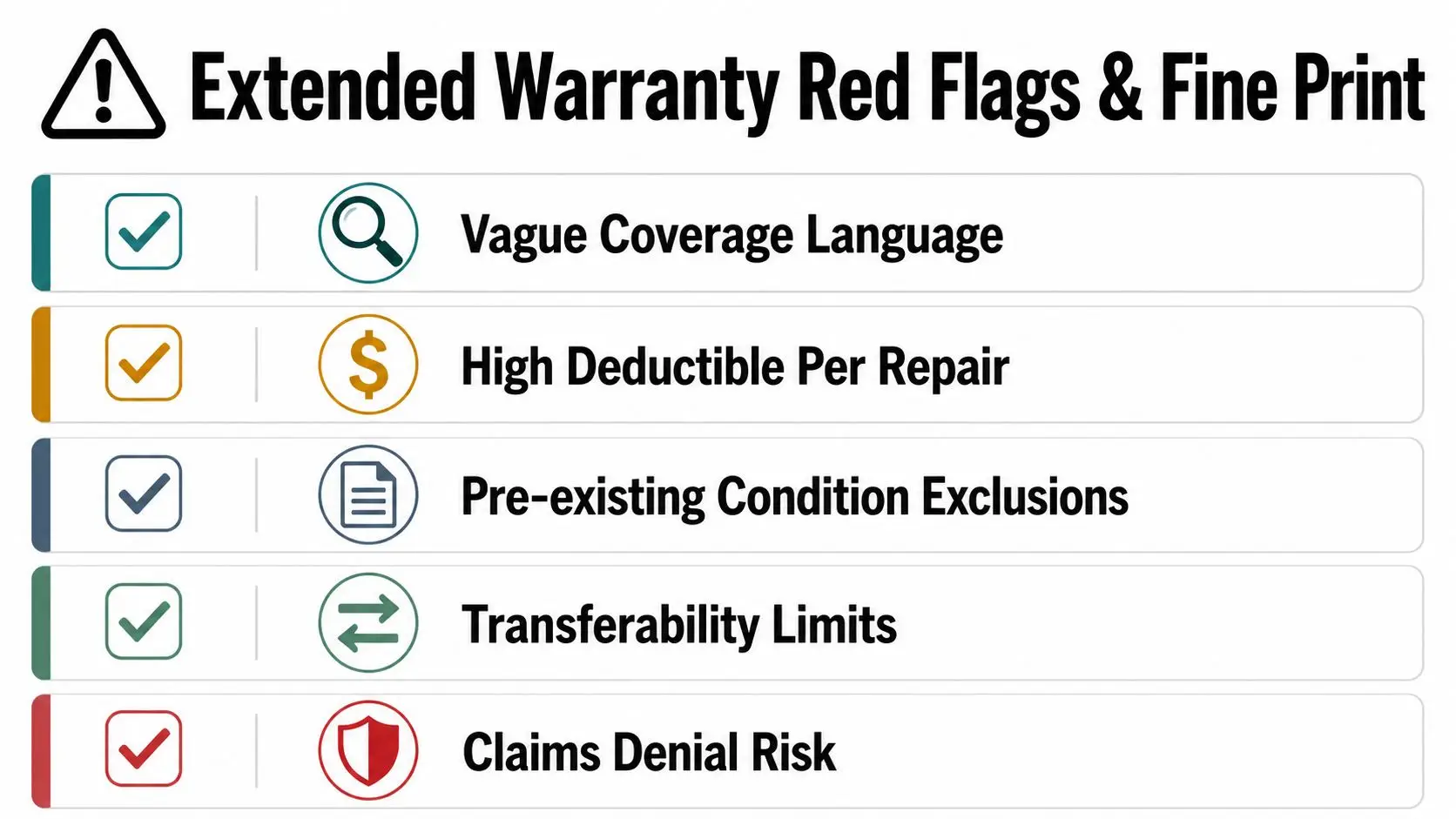
“Peace of mind” is a sales phrase, not a coverage definition. I've seen drivers believe they bought broad protection, then discover that the contract covered a component in theory but excluded the failed seal, wiring, fluid loss, diagnostic step, or resulting damage that made the repair necessary.
Start with the coverage language. A stated-component contract should identify parts clearly, not rely on vague references to “related systems” or “major mechanical components.” An exclusionary contract should provide a complete exclusion list and explain how the administrator handles disputes over whether a failure falls within that list.
Clauses that deserve a hard stop
- Unclear maintenance obligations: If the contract requires maintenance but doesn't explain acceptable proof, ask what records the provider will accept. Keep invoices showing the vehicle identification details, date, mileage, service performed, and parts or fluids used.
- Consequential damage exclusions: A covered component may fail and damage an uncovered component. The contract may pay for the original failure while denying the related repairs, leaving you with a large balance.
- Pre-authorisation requirements: Some providers require approval before diagnostics, teardown, parts ordering, or repairs. Starting work without permission can jeopardise the claim.
- Parts restrictions: Confirm whether the provider can require aftermarket or remanufactured parts, and ask who handles any warranty on those parts.
- Per-visit deductibles: A small repair may not make financial sense when a deductible applies every time the vehicle enters the shop.
- Cancellation controls: Check whether you can cancel, how refunds are calculated, and whether the provider can cancel or limit the contract under specified conditions.
- Wear and tear wording: Normal deterioration is different from a sudden mechanical failure, but the contract may define those terms broadly. Ask how the provider distinguishes them.
A contract that shifts the burden of proof onto you deserves extra caution. Canadian consumer guidance explains that the buyer may need to prove the defect is covered and that the contract terms were respected. The Office of Consumer Affairs warranty guidance also distinguishes a paid extended warranty from statutory consumer protections.
If the salesperson can't explain how a failed part gets approved, don't assume the contract will become clearer after the breakdown.
Walk away if the provider won't give you the full contract before purchase, refuses to identify the claims administrator, won't explain pre-authorisation, or relies on verbal promises that don't appear in writing. The right plan should withstand close reading.
How the Claims Process Actually Works
The claim begins when the vehicle develops a fault, not when the repair is complete. Your first move should be to protect the vehicle and contact the warranty provider before authorising diagnostic work, teardown, or parts replacement. Follow the roadside and towing instructions in the contract, then document what happened, including warning lights, noises, driving conditions, and whether the vehicle could still move safely.
Follow the approval chain
- Report the breakdown. Give the provider the contract number, vehicle identification details, current mileage, location, symptoms, and towing information. Ask for a claim number and write down the representative's name, date, and instructions.
- Confirm the repair facility. The provider may require a licensed facility, an approved network shop, or a particular inspection process. Don't assume your preferred shop can begin work without authorisation.
- Authorise diagnosis only as instructed. The shop needs to identify the failed component, but the contract may limit diagnostic coverage or require the provider's permission before disassembly.
- Submit a complete estimate. The repair facility may send diagnostic findings, labour hours, part numbers, fluid requirements, photographs, maintenance records, and evidence of the failure. A vague estimate creates room for dispute.
- Wait for the decision. An adjuster may review the estimate, request service history, ask for additional testing, or require an independent inspection. The shop shouldn't promise completion until the provider approves the covered work and explains your deductible or excluded balance.
- Complete and document the repair. Keep the final invoice, replaced-parts information, authorization number, payment receipt, and written explanation of anything the provider declined.
Quebec consumer guidance describes a similar burden on the customer. The buyer must show that the defect is covered and that the contract terms were followed, then seek repair or authorisation, negotiate with the business, send formal notice when necessary, and consider court only after those steps. The Office de la protection du consommateur's additional warranty guidance is Quebec-specific, but the documentation lesson applies to Ontario drivers dealing with contractual claims.
Build a claim file before you need it
Keep service invoices, inspection reports, registration documents, warranty correspondence, photos of warning messages, and towing receipts in one digital folder. Record every phone call in writing and ask the provider to email important decisions. If the provider denies the claim, request the exact contract clause, the technical reason for denial, and the information needed for reconsideration.
The timeline varies by provider, repair complexity, inspection requirements, and parts availability. Don't accept a verbal promise that approval is “automatic,” and don't authorise a major repair while assuming reimbursement will follow. Your repair facility can help organise technical evidence, but the contract holder remains responsible for complying with the plan.
How Carmedics Autowerks Supports Your Warranty and Repairs
A warranty claim needs more than a parts list. It needs a defensible diagnosis that separates the failed component from pre-existing conditions, maintenance issues, wear, accident damage, and unrelated symptoms. A repair facility can inspect the vehicle, record diagnostic findings, photograph relevant damage, identify the parts involved, and communicate the technical facts the administrator needs.
Carmedics Autowerks can be one local option for Whitby drivers who need help with inspections, repairs, and claim documentation. Its services include general auto repairs, fleet maintenance, collision repair, window tinting, and paint protection film installation. For customers using extended warranty coverage, the practical question is whether the shop can work within the provider's authorization process and document the repair clearly.
Make the paperwork part of the repair
Before work begins, ask the shop to help you confirm:
- What component failed and how the diagnosis supports that conclusion.
- Whether the provider requires pre-authorisation or a specific inspection.
- Which parts the contract permits.
- What the deductible covers and what remains your responsibility.
- Which maintenance records or prior invoices should accompany the claim.
- Whether the final invoice will identify labour, parts, taxes, and declined work separately.
Carmedics Autowerks states that it can perform warranty work for several extended-warranty providers and can seek accreditation from a warranty company when needed. That doesn't guarantee approval, and no repair shop can override an exclusion or create coverage that the contract doesn't provide. It can, however, give you a clearer starting point for a claim that depends on accurate diagnosis and organised records. You can review the shop's local services through Carmedics Autowerks in Whitby.
Bring the contract, maintenance file, vehicle details, and any claim instructions to the appointment. Ask for a written estimate before approving non-covered work, and keep copies of every document sent to the provider.
Carmedics Autowerks Inc offers general auto repair, diagnostics, collision repair, fleet maintenance, window tinting, and paint protection film services for Whitby drivers dealing with warranty-related repairs. Visit Carmedics Autowerks Inc to arrange an inspection or consultation and get your vehicle's condition and claim documentation reviewed before a small problem becomes an expensive dispute.