


You've just finished a long shift on the 401, the car has handled stop-and-go traffic through Whitby, and a small warning light appears as you pull into the driveway. The vehicle still drives, so it's tempting to ignore it. That's usually how a routine maintenance appointment turns into an inconvenient repair.
A proper car maintenance service gives you more than an oil change. It checks the systems affected by daily commuting, winter salt, short trips, cold starts, and uneven road wear, then records what needs attention before a minor issue leaves you stranded. Ontario's repair market reflects how important personal vehicles remain. Statistics Canada reported $40.9 billion in operating revenue for Canada's repair and maintenance services subsector in 2023, with automotive repair and maintenance representing 64.5% of that total. Ontario accounted for 35.1% of automotive repair and maintenance operating revenue that year, and provincial revenue rose 8.6% year over year. Statistics Canada's industry data puts Whitby firmly inside one of the country's most active automotive service markets.
What a Car Maintenance Service Actually Covers
A Whitby commuter notices the check engine light halfway home after a tiring day on the 401. The car isn't shaking, overheating, or losing power, so the driver books the earliest convenient appointment and keeps using it for school runs and errands. At the shop, the warning light becomes one part of a wider inspection rather than the entire diagnosis.
A car maintenance service is a planned visit where a technician inspects, tests, adjusts, and replaces service items that help the vehicle operate safely between major repairs. Maintenance is preventive. Repair addresses a component that has already failed or developed a fault. An oil and filter change is maintenance. Replacing a failed alternator, leaking radiator, or seized brake calliper is repair.
What the technician checks
A complete visit may include:
- Engine lubrication: The technician drains used oil, installs the correct filter, checks for leaks, and fills the engine with the manufacturer-specified oil.
- Braking hardware: Pads, rotors, callipers, hoses, and parking-brake operation receive a visual and measurement-based check.
- Tires and wheels: Pressure, tread condition, uneven wear, wheel damage, and rotation needs are reviewed.
- Fluids: Coolant, brake fluid, transmission fluid, power steering fluid where applicable, and washer fluid are checked for level and condition.
- Filters and battery: Cabin and engine air filters are assessed, while the battery and charging system are tested rather than judged by appearance alone.
- Safety equipment: Lights, wipers, belts, hoses, steering, suspension, and visible underbody components are inspected.
Practical rule: A maintenance appointment should leave you with a written picture of the vehicle's condition, not just a receipt showing that oil was changed.
That distinction matters in Whitby. A car can have clean oil and still have a weak battery, corroded brake hardware, a damaged splash shield, or tires wearing on the inside edge. The purpose of preventive maintenance for vehicles is to identify those developing concerns while the technician can still plan the work with you.
The Core Service Categories Every Vehicle Needs
A useful service conversation names the actual job being performed. “Full service” can mean different things at different shops, so ask what the technician will inspect, measure, and replace.
Start with oil, filters, and fluids
Engine oil carries heat and lubricates moving parts, but short Whitby trips can leave an engine repeatedly warming up without completing a long operating cycle. That pattern deserves attention when the shop reviews oil condition and the vehicle's maintenance history. The oil filter should be replaced with the oil, and the technician should look for seepage around the pan, filter housing, drain plug, and valve cover.
The engine air filter protects the intake system from dirt. The cabin air filter controls the air entering the passenger compartment and can become restricted by road dust, leaves, and winter debris. Neither filter should be replaced automatically without inspection, but both are easy to overlook when the appointment is treated as only an oil change.
Fluid checks aren't just top-ups. A technician looks for contamination, leaks, unusual colour, and signs of overheating in coolant, transmission fluid, brake fluid, power steering fluid where fitted, and washer fluid. Salt exposure can also corrode lines, fittings, and shields beneath the vehicle, so an underbody inspection matters after Durham Region winters.
Measure brakes, tires, and battery health
Stop-and-go driving around Taunton Road, Brock Street, and busy Durham Region intersections puts repeated heat cycles through the braking system. A proper brake inspection records pad thickness, rotor condition, calliper movement, hose condition, and signs of uneven wear. A squeal may be a warning, but quiet brakes can still have limited usable material.
Tire service includes pressure adjustment, tread inspection, sidewall checks, and wear-pattern analysis. Rotation is recommended only when the tire design and wear condition make it appropriate. A steering-wheel vibration may point toward balance, wheel damage, alignment, or suspension wear, not only a need for rotation.
The battery also deserves a test, especially before cold weather. A visual check can find terminal corrosion or a loose hold-down, but a proper battery and charging-system test provides more useful information about starting reliability.
For drivers who want several of these jobs handled together, one-stop auto service in Whitby can make the appointment easier to organise while preserving a single service record.
Typical Intervals and What Drives the Schedule
A vehicle that spends its week on the 401, idles in Durham Region traffic, and makes short winter trips should not be serviced on the same plan as one used mainly on open roads. The owner's manual remains the final authority, particularly for turbocharged engines, hybrid systems, automatic transmissions, timing components, and vehicles with specific fluid requirements.
The table provides general planning ranges, not a replacement for the manufacturer's schedule. Use whichever limit arrives first, kilometres or months.
Typical Car Maintenance Intervals for Ontario Drivers
| Service Item | Standard Interval | Severe-Service Interval, Whitby Commute |
|---|---|---|
| Engine oil and filter | About 8,000 to 16,000 km or 6 to 12 months | About 5,000 to 8,000 km or 4 to 6 months |
| Tire rotation | About 8,000 to 12,000 km or with scheduled oil service | About 6,000 to 8,000 km or with oil service |
| Brake-fluid inspection or service | Inspect at each maintenance visit, replace according to the manufacturer schedule | Inspect at each visit, consider earlier service if moisture or contamination is found |
| Coolant | Inspect at routine service, replace according to vehicle schedule | Inspect more closely where towing, overheating, or contamination is present |
| Transmission service | Follow the manufacturer's fluid and filter schedule | Use the severe-service schedule for frequent idling, towing, short trips, or heavy traffic |
| Spark plugs | Follow the engine-specific schedule | Follow the severe-use schedule where the manufacturer provides one |
These ranges sit alongside understanding service intervals for normal and severe use. A car driven gently on open highways sees fewer cold starts and less brake heating than one used for short errands, school drop-offs, extended idling, and daily 401 commuting.
What shortens an interval
Towing, hauling, dusty roads, repeated short trips around Whitby and Oshawa, and long periods of idling all increase service demands. Winter cold puts more strain on starting systems, while salt and moisture attack brake lines, fasteners, exhaust components, and underbody hardware.
Highway driving, gentle acceleration, and garage storage can reduce some forms of wear. They do not justify extending the schedule beyond the manual. For many Whitby drivers, the manufacturer's severe-service schedule better reflects real use than the standard schedule.
Use how often you should service your car as a starting point, then match it to your actual commute, winter exposure, and time spent in stop-and-go traffic.
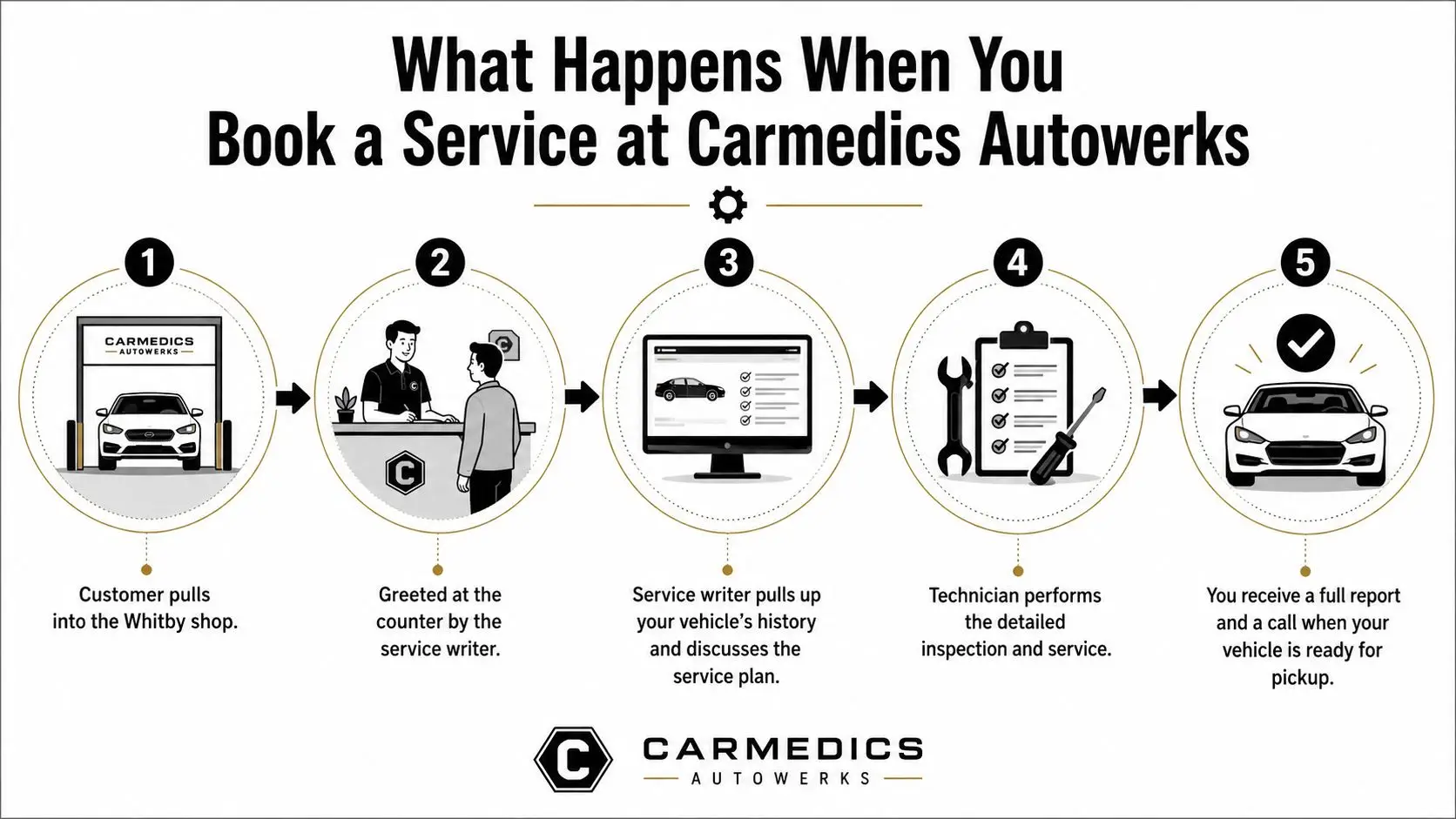
What Happens When You Book a Service at Carmedics Autowerks
The visit should feel organised from the moment you pull into the Whitby shop. At the counter, the service writer confirms the vehicle identification, reviews its service history, and asks what has changed since the last visit. Mention the 401 commute, short winter trips, towing, unusual sounds, dashboard messages, or any recent tire or battery work. Those details help the technician interpret what the inspection reveals.
The car then moves into the bay. The technician checks service items from the work order, raises the vehicle where appropriate, inspects the underside for corrosion and damage, checks fluid levels and visible leaks, measures brake components, examines tires, and performs relevant battery or diagnostic tests. A visual inspection without measurements can miss a brake pad that looks acceptable from outside but is wearing unevenly on the inside.
How approval should work
If the technician finds something beyond the scheduled service, the shop should contact you before proceeding. The conversation should explain the finding, show its condition where possible, separate safety concerns from future recommendations, and provide pricing before extra work begins.
That process protects both sides. You can decide whether a worn tire, corroded brake line, fluid leak, or weak battery needs attention now, while the shop avoids performing unauthorised work. A clear estimate should identify parts, labour, applicable taxes, and any diagnostic time involved.
At pickup, you should receive a record showing what was completed, what was inspected, and what needs monitoring. A digital vehicle inspection with photographs can make those findings easier to understand than a handwritten note. The useful outcome isn't a serviced car. It's knowing what condition the vehicle is in and what deserves attention before the next appointment.
Warning Signs That Should Send You to the Shop
A symptom that appears only after the 401 commute, during stop-and-go Durham Region traffic, or on a cold Whitby morning can help narrow the fault. Tell the technician when it starts, whether the engine is warm or cold, your speed, and whether braking, turning, or accelerating changes it. Clear details can shorten diagnosis.
| Warning Sign | Likely System | Urgency |
|---|---|---|
| Check engine light | Engine management, emissions, ignition, fuel, or sensor systems | Book promptly. Stop if the light flashes or the vehicle runs badly |
| Brake squeal or grinding | Brake pads, rotors, callipers, or hardware | Grinding or reduced braking needs immediate attention |
| Pulling under braking | Brake imbalance, tire issue, alignment, or suspension | Arrange inspection soon. Avoid continued driving if control is poor |
| Slow crank on a cold morning | Battery, starter, cables, or charging system | Book before the vehicle fails to start |
| Steering-wheel vibration above 80 km/h | Wheel balance, tire damage, alignment, or suspension | Reduce speed and arrange inspection, especially if vibration is severe |
| Fluid spot on the driveway | Engine, coolant, transmission, brake, or power-steering system | Identify the fluid promptly. Do not drive if brake fluid is leaking |
| Sweet smell from the vents | Coolant leak, heater core, or cooling-system concern | Stop if the temperature rises or the windshield fogs with coolant residue |
A check engine light does not identify the failed component by itself. The technician must scan the vehicle, interpret stored information, and compare it with live operating data. Our guide to what a check engine light means helps you decide how quickly to arrange that assessment.
Salt from Durham Region winters can leave corrosion around brake lines, exhaust components, battery connections, and other exposed hardware. A new electrical warning, difficult starting, or a brake pedal that feels different deserves attention, even if the car still drives normally.
Some symptoms can wait a few days for a planned appointment. A flashing warning light, overheating, loss of braking, strong fuel smell, steering-control problem, or rapidly worsening noise should be treated as a drive-home-now issue. If you are unsure, stop somewhere safe and call Carmedics Autowerks rather than guessing.
Choosing Between a Dealership and an Independent Shop in Whitby
The right shop depends on the vehicle, the work, and the kind of support you value. A dealership offers direct access to factory procedures, brand-specific diagnostic equipment, and technicians who regularly see that manufacturer's models. That can be useful for warranty concerns, software updates, recalls, and complex brand-specific faults.
An independent shop usually offers broader vehicle coverage and a more continuous relationship as a car ages. A specialty shop can be the strongest choice when the vehicle has a narrow technical need, such as performance tuning, a particular European brand, a transmission concern, or advanced electrical diagnosis.
| Factor | Dealership | Independent Shop | Specialty Shop |
|---|---|---|---|
| Routine oil service | Brand-specific process, often with manufacturer scheduling | Flexible service options and broader vehicle coverage | May focus on the system or brands it knows best |
| Vehicle familiarity | Strong within its franchise | Builds history across many makes and models | Deep knowledge of selected systems or brands |
| Parts choice | Commonly factory-branded parts | OEM and quality aftermarket options may be available | Parts selected for the specialty and repair objective |
| Booking availability | Can be busy during seasonal peaks | Often more flexible, depending on shop capacity | Availability varies with specialist demand |
| Warranty questions | Direct manufacturer process | Can perform maintenance without automatically voiding coverage when work follows requirements | Best when the repair falls within its expertise |
| Long-term record | Centralised within the dealer network | One local history across maintenance and repairs | Strong record for the work it performs |
A newer vehicle under manufacturer coverage may make dealership servicing practical, particularly when software or warranty documentation matters. A fleet operator may prioritise scheduling and predictable maintenance control. An owner of an older car often benefits from an independent shop that knows the vehicle's history and can compare repair options without limiting the conversation to one brand.
For many Whitby drivers, a trusted independent shop becomes the sensible long-term choice after the factory warranty period, especially when it combines proper diagnostics, transparent estimates, quality parts, and consistent records.
What Makes a Whitby Maintenance Shop Worth Trusting
Price matters, but a low quote isn't useful if it excludes the inspection, uses unsuitable parts, or leaves you without a record of what happened. Trust starts with accountability. Ask who will work on the vehicle, what qualifications and training they hold, and how the shop stays current with computerised systems, hybrid technology, driver-assistance features, and manufacturer procedures.
A strong shop should be able to explain its process plainly:
- Qualified technicians: Look for Automotive Service Technician or Red Seal credentials, along with evidence of ongoing technical training.
- Written estimates: You should know the expected work and price before authorising it.
- Documented findings: Photos, measurements, scan results, and clear notes are more useful than vague recommendations.
- Parts transparency: Ask whether the repair uses OEM or quality aftermarket parts and what warranty applies.
- Approval controls: Confirm that the shop will contact you before exceeding the authorised repair amount.
- Vehicle care: Fender covers, floor protection, tidy bays, and direct answers show respect for the vehicle and its owner.
Ontario consumers can also check how a business approaches regulatory accountability and industry participation through organisations such as the Ontario Motor Vehicle Industry Council and the Automotive Industries Association of Canada. Membership alone doesn't prove repair quality, but it gives you another question to ask and another signal to evaluate.
Carmedics Autowerks offers general auto repair, fleet maintenance, diagnostics, tire work, heating and cooling service, and mechanical repairs for Whitby drivers. Its service process includes ASE-trained technicians, digital inspections with photos, and warranty coverage on parts and labour. Those details matter because they give the customer a traceable explanation of the work rather than relying on a verbal assurance.
A Simple Maintenance Rhythm for Whitby Drivers
A seasonal routine helps you match preventive work to the conditions your vehicle faces. It doesn't replace the owner's manual, but it gives you useful checkpoints between scheduled services.
Spring
Book an inspection after the winter season. Ask the technician to check underbody corrosion, brake lines and hardware, suspension components, wipers, and coolant condition. A thorough wash that reaches the undercarriage can remove salt residue, but it shouldn't replace a mechanical inspection.
Summer
Have the tires checked for uneven wear and correct pressure. Confirm that the air-conditioning system cools properly before a hot commute, and inspect the cooling system for leaks or damaged components. Keep washer fluid available because summer road spray and insects can quickly reduce visibility.
Fall
Test the battery and charging system before cold starts become routine. Check heater output, exterior lighting, wipers, tire condition, and the condition of any winter tires before installation. Don't wait for the first snow to discover that a headlight is out or a tire has developed a slow leak.
Winter
Pay attention to oil life and starting behaviour, particularly if most trips are short. Keep the fuel tank above half to reduce the risk of condensation, and wash the undercarriage regularly when roads have been heavily salted. If the battery cranks slowly or a warning light appears, arrange service before the vehicle refuses to start.
Between appointments, walk around the car monthly. Check tire pressure, look for fresh fluid spots, listen for brake noise, and watch for new dashboard warnings. Book a full seasonal inspection at Carmedics Autowerks and keep the report as a baseline for future visits.
Carmedics Autowerks Inc offers routine maintenance, inspections, diagnostics, brake and tire service, fleet maintenance, and mechanical repairs for Whitby cars and SUVs. Visit Carmedics Autowerks Inc to book a maintenance appointment, discuss a warning sign, and leave with a clear record of what your vehicle needs next.