

A useful Ontario benchmark is C$5,044 for the average repairable auto-insurance claim in the first half of 2023, and that figure could approach C$5,500 in the following year. A small dent can still become a four-figure bill once calibration, refinishing, hidden damage, and replacement parts enter the estimate.
A Whitby driver usually discovers this at the worst possible time. The car has a parking-lot dent, the bumper still looks attached, and there's no warning light on the dash. You expect a quick repair. Then the shop removes a trim panel, checks the sensors, measures the damage, and produces an estimate that looks far larger than the dent itself.
That reaction is understandable, but the estimate isn't necessarily inflated. Modern vehicles turn bodywork into a combination of structural repair, paintwork, electronics, scanning, and safety-system verification. What you're paying for isn't just a repaired panel. It's a documented repair that restores the vehicle properly.
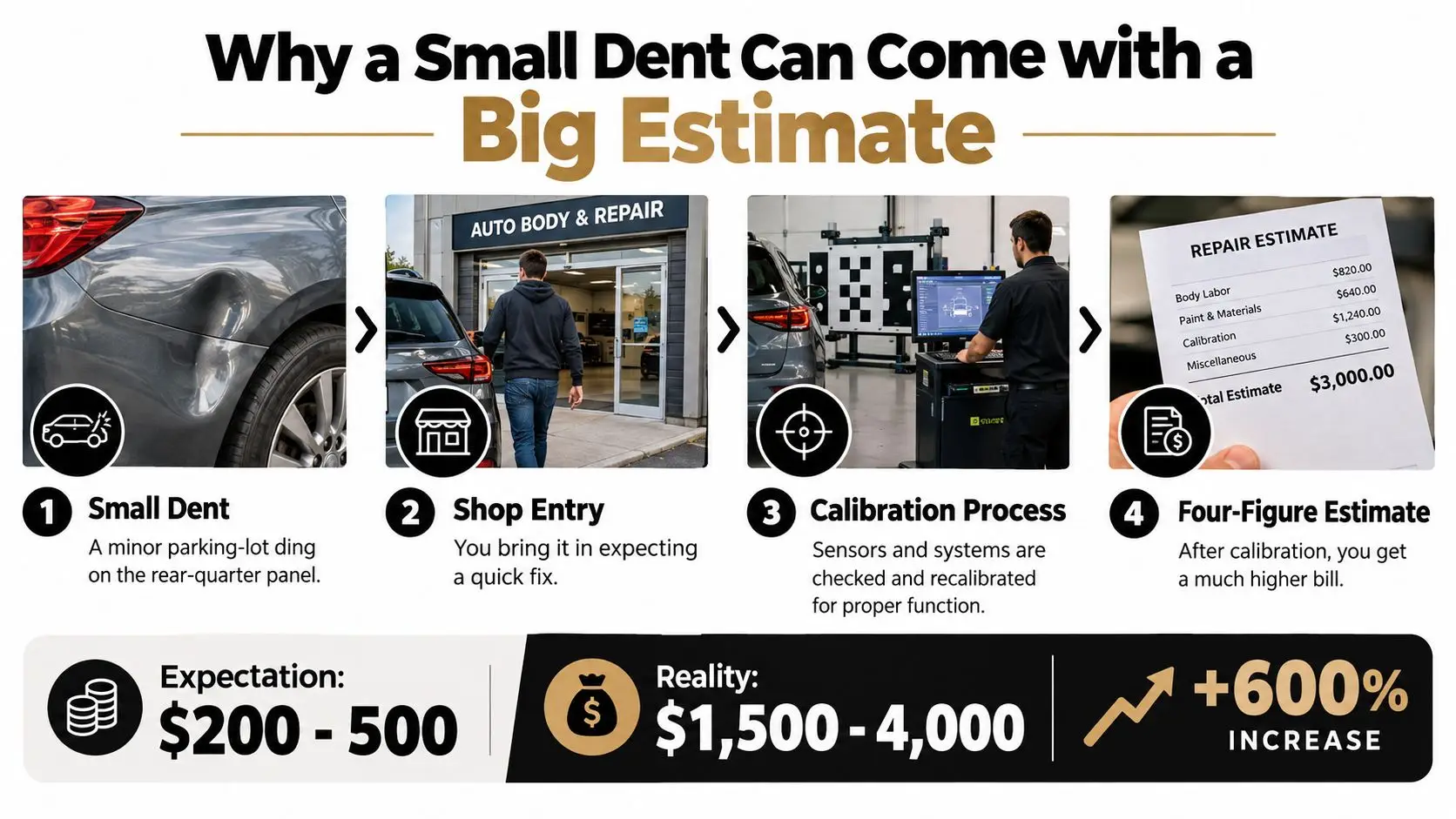
Why a Small Dent Can Come with a Big Estimate
A Whitby driver recently brings in a rear-quarter panel with a parking-lot dent. The damage looks contained, and the first thought is paintless dent repair. After inspection, the repair path changes. The panel needs conventional repair and refinishing, the adjacent panels need blending so the colour matches, and the vehicle's driver-assistance systems require checking because the impact occurred near sensor equipment.
The driver walked in expecting a modest cosmetic job and walked out looking at a four-figure estimate. The surprise came from the work that wasn't visible from the outside.
The panel is only one part of the repair
A dented bumper or quarter panel may sit beside radar units, cameras, ultrasonic sensors, wiring, brackets, or mounting points. A panel can look straight while a bracket has moved. A bumper cover can be replaced perfectly and still require a scan or calibration before the vehicle is ready.
The Insurance Institute of Canada's collision-repair analysis, citing Mitchell claims-performance data, reported an average repairable claim of C$5,044 in the first half of 2023, which was 12% higher than the previous year. The same analysis projected that the average could approach C$5,500 in 2024. That isn't a quote for your Civic, F-150, or BMW, but it shows why modern repair bills often reach several thousand dollars.
The analysis also reported that calibration was required on about 10% of repairable Canadian vehicles. For a Whitby driver, the lesson is straightforward. A quote based only on visible damage is incomplete until the shop has considered teardown, parts, paint, structural condition, scanning, and calibration.
Practical rule: Judge an estimate by the operations it includes, not by the size of the dent.
For a minor dent with no paint damage, paintless dent removal in Whitby may be appropriate. Once paint is cracked, metal is stretched, a panel edge is distorted, or safety equipment is involved, the repair belongs in a more detailed assessment.
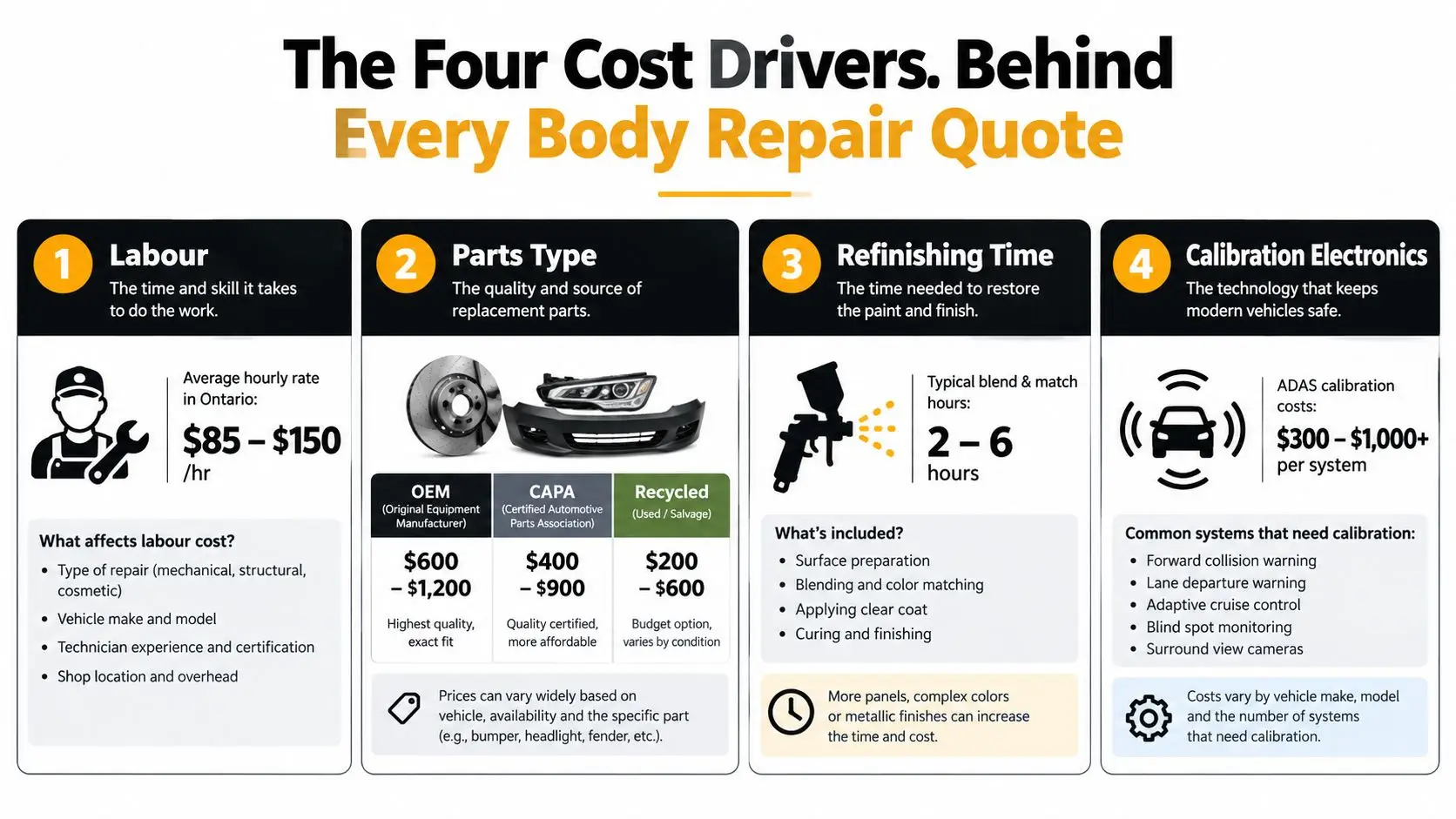
The Four Cost Drivers Behind Every Body Repair Quote
A Whitby driver can approve a bad estimate in seconds by looking only at the total. Read the operations instead. Every body repair quote is built from four cost drivers: labour, parts, refinishing, and electronics. Each line should explain what the shop will do, what it will install, and what must be tested before delivery.
Labour category and rate
Body labour includes removing trim, repairing metal, replacing panels, and reassembling the vehicle. Structural repairs require different work from cosmetic panel repairs, while refinishing has its own labour category. A clear estimate names each operation instead of hiding everything in one blended hourly charge.
The shop's rate pays for technician skill, measuring equipment, training, facility costs, administration, and insurer requirements. The Insurance Institute of Canada's collision-repair analysis reported that Ontario's national average body-work rate rose from C$72 to C$75 per hour over one year. Do not judge a quote by the rate alone. A higher rate with fewer required hours can cost less than a low-rate estimate that leaves out teardown, measuring, or reassembly.
Parts determine more than the purchase price
The estimate should identify whether each replacement is an OEM part, aftermarket part, recycled part, or certified alternative. That choice affects fit, finish, availability, sensor mounting, corrosion protection, and documentation. Ontario insurance claims can also involve different priorities for the insurer, repairer, and vehicle owner, so ask who approved the selected part.
Ask these questions before authorizing the work:
- What part was quoted? Get the manufacturer, description, and part number.
- Is it new or recycled? A recycled door or bumper may work well, but its condition and preparation still need review.
- Does the part carry the required mounting points? A bumper can look correct and still fail to support sensors properly.
- Who approves the choice? Confirm whether the insurer, shop, and vehicle owner agree.
A lower parts price is not a saving if poor fitment creates extra preparation, delays, or a calibration requirement.
Refinishing spreads beyond the damaged area
Paint work usually extends beyond the dent itself. The technician may need to prepare the repaired panel, apply colour, add clear coat, and blend into an adjacent panel. Metallic and pearl finishes demand careful matching, particularly when the vehicle's paint has faded from sun exposure.
The estimate should list the repaired panel, blend panels, refinishing operations, and paint materials separately. A fender repair may include part of the door, while a quarter-panel repair may require blending into the rear door. If those lines are missing, ask whether the colour match and blend work are included or likely to appear after teardown.
Electronics add a second repair layer
ADAS, or advanced driver-assistance systems, may include forward cameras, radar, lane-keeping equipment, blind-spot sensors, parking sensors, and surround-view cameras. Damage or replacement involving a bumper, grille, mirror, windshield, quarter panel, or tailgate can change a sensor's position or viewing angle.
A detailed breakdown of ADAS calibration cost shows that calibration may use manufacturer-specific targets on a level floor or a controlled road test for dynamic calibration. The ADAS calibration service information describes common California estimate ranges of approximately US$200 to US$800 for one repair and US$800 to US$1,500 when several systems are involved. Those are not Ontario quotes. The practical point is clear: calibration belongs on its own estimate line, with the required scan or test identified.
Common Body Repairs and What They Typically Cost
The honest answer to “what does this repair cost?” is that Ontario doesn't have one dependable price list for every vehicle and shop. A small steel dent, a damaged sensor bracket, and a quarter panel with hidden structural damage may look similar in a photograph but require completely different operations.
Use the table as a decision guide, not as a substitute for a written estimate. The only broad Ontario benchmark available here is the average repairable insurance claim cited earlier, and it isn't a guaranteed price for an individual job.
| Repair Type | Typical Ontario Price Range |
|---|---|
| Paintless dent repair | Vehicle-specific estimate required. Usually considered for accessible dents without broken paint or stretched metal. |
| Conventional dent repair and paint | Vehicle-specific estimate required. Cost rises with metal distortion, filler work, colour matching, and blending. |
| Bumper cover repair and refinishing | Vehicle-specific estimate required. Check for sensor mounts, parking sensors, hidden reinforcement damage, and calibration. |
| Bumper cover replacement and refinishing | Vehicle-specific estimate required. Confirm the part type, paint materials, hardware, scans, and calibration. |
| Full panel replacement | Vehicle-specific estimate required. Ask whether the estimate includes corrosion protection, seam sealer, blending, and reassembly. |
| Paint correction or local respray | Vehicle-specific estimate required. A polishable surface defect is a different job from damaged paint that needs preparation and refinishing. |
| Paint protection film | Vehicle-specific estimate required. Coverage area, film choice, preparation, and panel condition affect the quote. |
| Collision repair | Vehicle-specific estimate required. Teardown may reveal structural, suspension, airbag, electrical, or sensor work. |
A bumper repair cost assessment should separate cosmetic repair from replacement and should identify whether the bumper contains parking or collision-avoidance equipment. A bumper that only needs refinishing is in a different category from one that has damaged brackets, wiring, radar mounts, or impact absorption components.
The quick rule is simple. If the damage is a clean, shallow dent and the paint is intact, ask about paintless dent repair. If the paint is broken, expect refinishing. If a panel is cracked, sharply folded, or close to sensors, expect a more involved estimate. If the estimate approaches the vehicle's value, discuss insurance and total-loss implications before authorizing teardown.
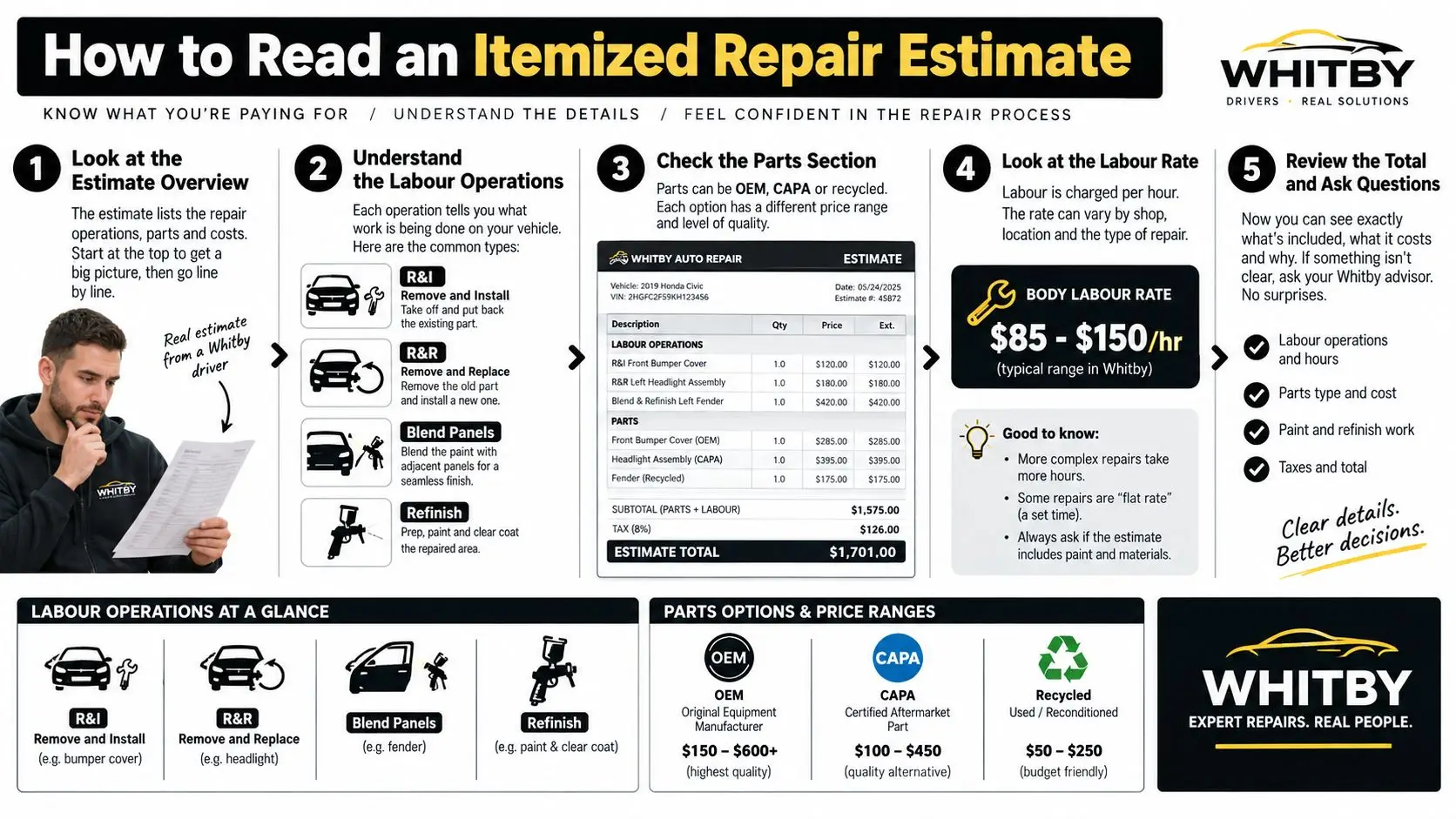
How to Read an Itemized Repair Estimate
Don't approve a body estimate because the total looks reasonable. Read the operations first.
A proper estimate for a fender and bumper repair may contain many lines because each line represents a different task. The abbreviations matter:
- R&I, or remove and install: The original part comes off and goes back on.
- R&R, or remove and replace: The damaged part is removed and a replacement is installed.
- Repair: The technician restores the original part rather than replacing it.
- Blend: Colour is feathered into an adjacent panel to create a consistent appearance.
- Refinish: The panel is prepared, painted, and clear-coated.
- Scan or calibration: The vehicle's electronic systems are checked, aimed, or verified.
A line-by-line estimate audit
Start with the damaged panel. Confirm whether the estimate says repair or replacement. If replacement is listed, check whether it identifies OEM, aftermarket, or recycled supply.
Then inspect the labour cluster. Look for body labour, structural labour if relevant, refinishing labour, and reassembly. A quote that lists one large labour amount without describing the operations is harder to assess.
Next, find parts and materials. Hardware, clips, mouldings, adhesives, seam sealer, corrosion protection, paint materials, and shop supplies may appear separately. Those lines aren't automatically improper, but the shop should explain them when asked.
Sublet work deserves attention too. Towing, glass work, alignment, scanning, calibration, and specialist structural measurement may be performed by another provider. Ask whether the estimate includes a sublet charge and whether any markup applies.
The red flags are duplication and omission. Two operations may be combined by estimating software, or a necessary operation may be missing until teardown. Don't accuse a shop of padding the estimate because it has many lines. Ask what each line accomplishes and whether it is required by the vehicle manufacturer or the repair method.
A short estimate isn't automatically efficient. It may simply leave the difficult work for a supplement.
Ontario Insurance Rules That Shape Your Out-of-Pocket Cost
The repair total and your personal cost are different figures. Your deductible is the most obvious difference, but it isn't the only one. Policy terms, the type of claim, the vehicle's value, excluded items, and the insurer's repair decision all matter.
Ontario's Financial Services Regulatory Authority states that the insurer pays the lower of the repair cost or the vehicle's actual cash value at the time of damage, less the deductible shown on the automobile insurance certificate. That means a vehicle can move from “repairable” to “total loss” when the documented repair no longer makes financial sense against its pre-loss value.
| Trigger | What It Means | Driver's Cost Impact |
|---|---|---|
| Deductible applies | The policyholder contributes the amount shown on the insurance certificate. | You pay the deductible even when the insurer authorizes the balance. |
| Estimate reaches actual cash value | The insurer may settle the vehicle as a total loss rather than approve every repair operation. | Your replacement or settlement options depend on the vehicle valuation and policy terms. |
| Driver disputes value or repair cost | The matter may be referred to appraisal under Ontario's Insurance Act. | The request must be made in writing, and the insurer must participate, according to FSRA's automobile insurance guidance. |
| Driver chooses a shop | The driver may choose the repair facility, provided the insurer approves the estimate. | A preferred-network restriction doesn't automatically remove your ability to ask another shop for an estimate. |
| Vehicle receives a severe-damage brand | The vehicle may become Salvage, Rebuilt, or Irreparable under Ontario's branding system. | Registration, inspection, future value, and financing can be affected. |
A claim after a collision on Taunton Road or the 401 should start with photographs, information exchange, and prompt insurer notification. Don't authorise extensive teardown before the claim process is clear if you expect insurance to pay.
Ontario's claims environment also helps explain why premiums and repair economics feel difficult. Statistics Canada's insurance analysis reported Ontario claims ratios of 79% in 2022 and 82% in 2023, with Ontario contributing the most to national insurance expenses and revenues. Those figures cover more than bodywork alone, but they show the financial pressure surrounding claims.
For insurance-specific planning, review car repair insurance guidance with the shop and your insurer. Ask about rental or loss-of-use coverage before you hand over the keys, because those benefits depend on the policy and claim circumstances.
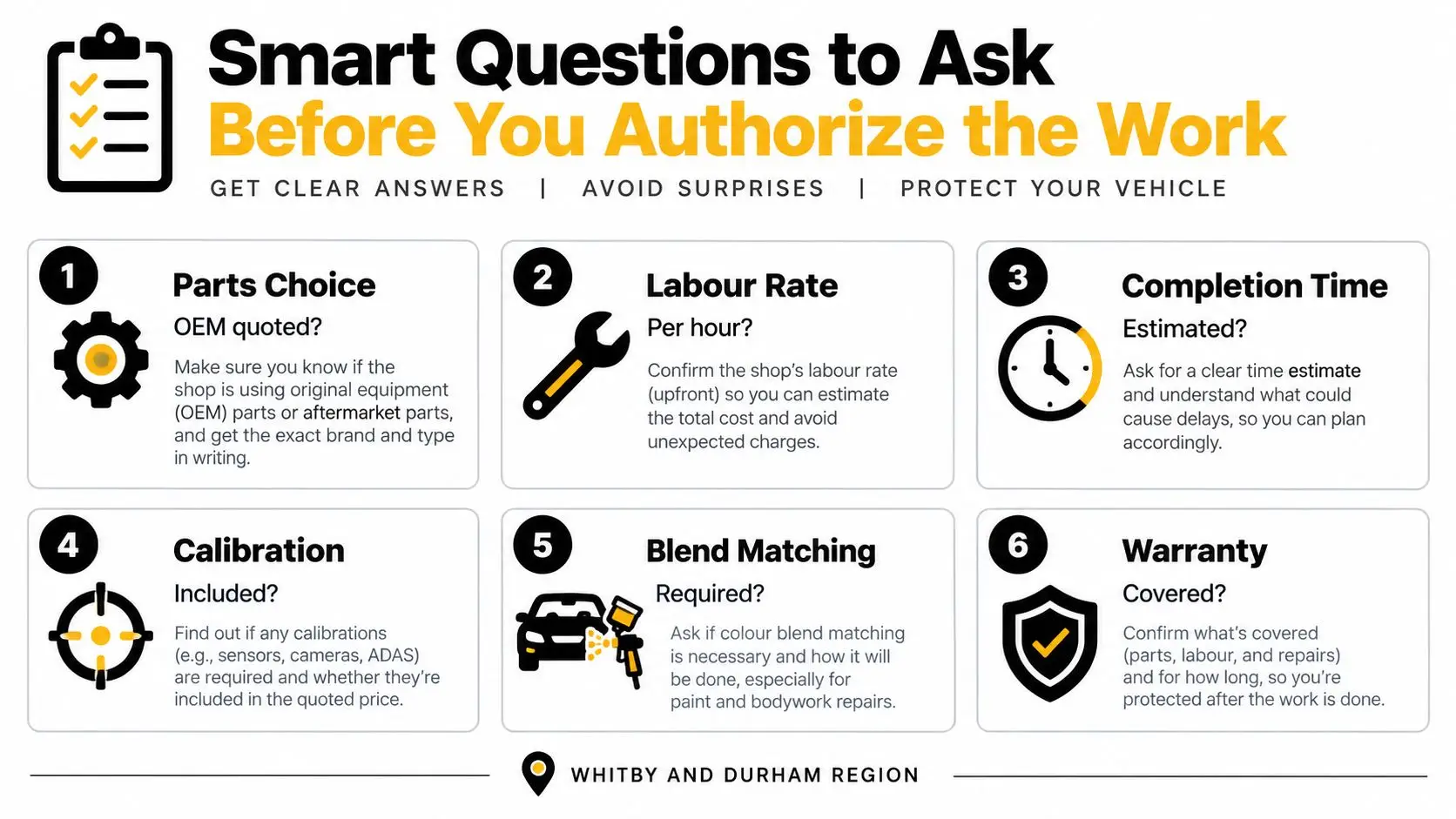
Smart Questions to Ask Before You Authorize the Work
Take the estimate home or review it at the counter. A good advisor should explain the repair without becoming defensive.
Ask:
- Which parts are being used? Was OEM quoted, and if not, is the replacement aftermarket or recycled?
- What is the labour rate for each operation? Ask for body, structural, refinishing, and specialty work separately.
- How many hours are allowed? Have the shop explain the major operations rather than presenting one unexplained total.
- Is ADAS calibration included? Ask whether the specific VIN requires calibration after this repair, and whether pre-repair and post-repair scans are documented.
- Which panels need blending? A colour match may require work beyond the damaged panel.
- What happens if teardown reveals more damage? Confirm how supplements are documented and sent to the insurer.
- Are sublet charges or markups included? This is particularly important for glass, alignment, calibration, towing, and specialist structural work.
- What warranty applies? Ask what the shop covers for bodywork and refinishing, and obtain the terms in writing.
- When will the vehicle be ready? Request an estimated completion date, while recognising that parts delays and supplements can change it.
- How was the vehicle documented? Photos at intake help establish its condition before repair begins.
Certification can help you compare facilities, but it doesn't replace a clear estimate. Ask whether the technicians have relevant I-CAR training or Collision Industry Assistance credentials, and ask how the shop verifies manufacturer repair procedures.
If an estimate exceeds your deductible by only a small margin, get a second opinion before filing or authorizing the work. A collision-repair facility such as Carmedics Autowerks can review the visible damage and explain which costs may change after teardown.
Misconceptions That Cost Whitby Drivers Money
The lowest quote is the best deal. It isn't if the quote omits blending, correct hardware, corrosion protection, scanning, or calibration. Compare the operations, parts, and documentation instead of comparing totals alone.
Insurance will pay the entire bill. Your deductible remains relevant, and the insurer's responsibility is limited by the policy and the vehicle's actual cash value. A repair estimate can also change after hidden damage is found, so confirm who approves supplements before work expands.
Calibration is a money grab. It isn't a cosmetic add-on when a collision may have changed a sensor's position or viewing angle. A vehicle can drive normally while a camera or radar system is no longer aimed correctly. Ask for the manufacturer procedure and the calibration result.
A warning light would tell me if something is wrong. Warning lights are useful, but their absence doesn't prove that every sensor is accurate. Sensor alignment, mounting position, and camera view can affect system performance without producing an immediate dashboard alert.
Any shop can match dealership work. Some independent facilities perform excellent repairs, but you should still ask about training, equipment, parts, manufacturer procedures, documentation, and insurer approval. A shop's location in Durham Region doesn't tell you whether its process suits your vehicle.
A low price means the car is road-ready. Ontario branding rules matter. The Ministry of Transportation's mandatory vehicle branding programme states that an Irreparable vehicle is restricted to parts or scrap, while a Salvage vehicle must be rebuilt and pass the required structural inspection before it can be rebranded Rebuilt and considered for registration.
Quick Answers Whitby Drivers Ask After the Estimate
How long will the repair take? Minor dent work may be completed quickly when the repair method and parts are straightforward. Collision claims can take much longer when parts, supplements, structural measurement, paint blending, glass, or calibration are involved. Ask for a target completion date and what could change it.
Will insurance provide a rental vehicle? Rental or loss-of-use coverage depends on your policy and claim circumstances. Confirm eligibility and limits with the insurer before the vehicle enters the shop.
What should I do immediately after a collision? Photograph the vehicles and scene when safe, exchange information, report the collision where required, and notify your insurer. Don't begin major teardown before the claim process and estimate approval are clear.
Can I request OEM parts? Ask the shop and insurer what part type is being proposed, then request the part number and reason for the choice. The final option can depend on the policy, vehicle, availability, and repair requirements.
What happens when hidden damage appears? The shop documents the new damage and submits a supplement for approval. Ask whether the vehicle will remain disassembled while the insurer reviews it and whether the completion date changes.
Can a Salvage vehicle be repaired cheaply? No. Ontario's structural inspection regulation requires chassis control and reference points to remain within 3 millimetres of the manufacturer's specification unless the manufacturer permits a greater variance. The Ontario inspection regulation also requires access to repaired joints and inspection of structural components, so exterior appearance alone isn't enough.
Carmedics Autowerks Inc offers collision-repair assessments, itemized estimates, refinishing, dent repair, and bodywork for Whitby drivers who want the operations explained before authorizing repairs. Visit Carmedics Autowerks Inc with your estimate or vehicle details, and ask the team to identify the parts, paint, structural, scanning, and calibration items that will determine your real car body repair cost.