

You're standing at a Whitby repair counter, keys in hand, and the total on the screen is higher than the number you expected. The service advisor points to a few short descriptions, the parts are already installed, and you're trying to decide whether you're looking at a fair, properly documented bill or a charge that needs questioning.
A car repair invoice is more than a payment receipt. It records what you authorized, what the shop says it completed, how labour and parts were priced, and what warranty terms apply. In Ontario, that paperwork can also become important evidence if you need a second opinion, make a complaint, or challenge the quality or cost of a repair.
What a Car Repair Invoice Really Is and Why It Matters
At pickup, many drivers look first at the total, then at the tax, and finally at the payment terminal. A better approach is to treat the invoice like a detailed receipt with a built-in warranty card. Each line should help answer three practical questions: What was approved, what was done, and what protection applies afterward?
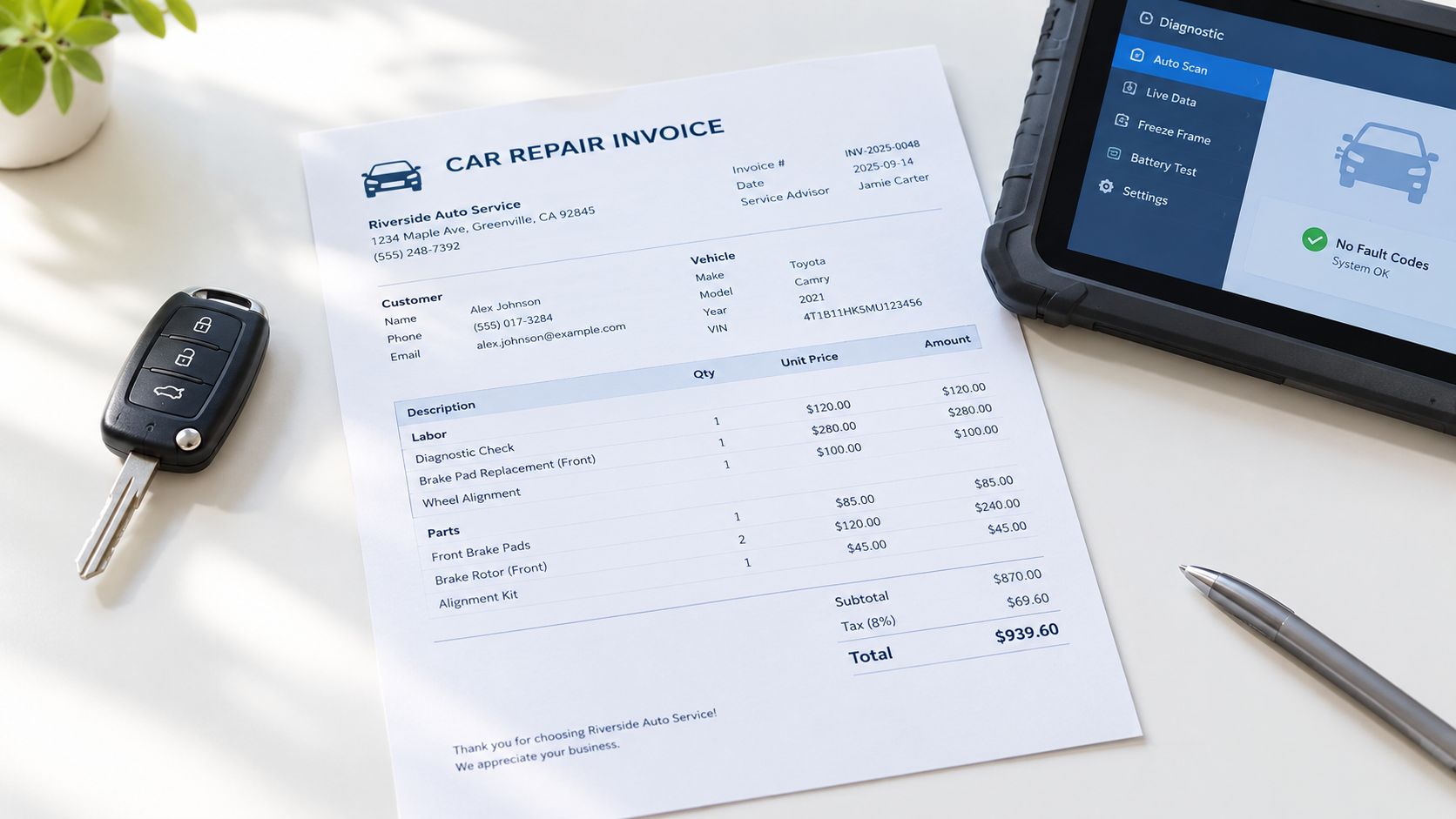
Suppose your vehicle came in for a warning light and the shop found a failed component. A useful invoice won't just say “repair completed” and show one lump sum. It should identify the vehicle, describe the work, show the parts used, explain labour, list applicable fees and taxes, and state the warranty terms. That detail gives you something concrete to compare with the estimate and with the work you approved.
Practical rule: A vague total is difficult to verify. An itemized invoice lets you ask focused questions without turning a routine pickup into an argument.
The document also has value after payment. Keep it with your service records for future maintenance, warranty discussions, insurance matters, resale, or a second-shop assessment. If a later problem appears, the invoice can show whether the original shop identified the part, recorded the odometer, and described the work clearly.
Ontario's consumer guidance explains the rights connected with car repairs, while broader car-repair resources such as Gerald Technologies car repair help can help drivers become more familiar with repair terminology before they approve work. For local service, you can also review the Carmedics Autowerks auto repair service and use the same documentation standards when comparing any shop.
A clear invoice protects the driver and the repairer. The driver can see what was charged, and the shop can show what it was asked to do. That shared record is why reading the page carefully can save stress later.
How to Read Every Line on Your Car Repair Invoice
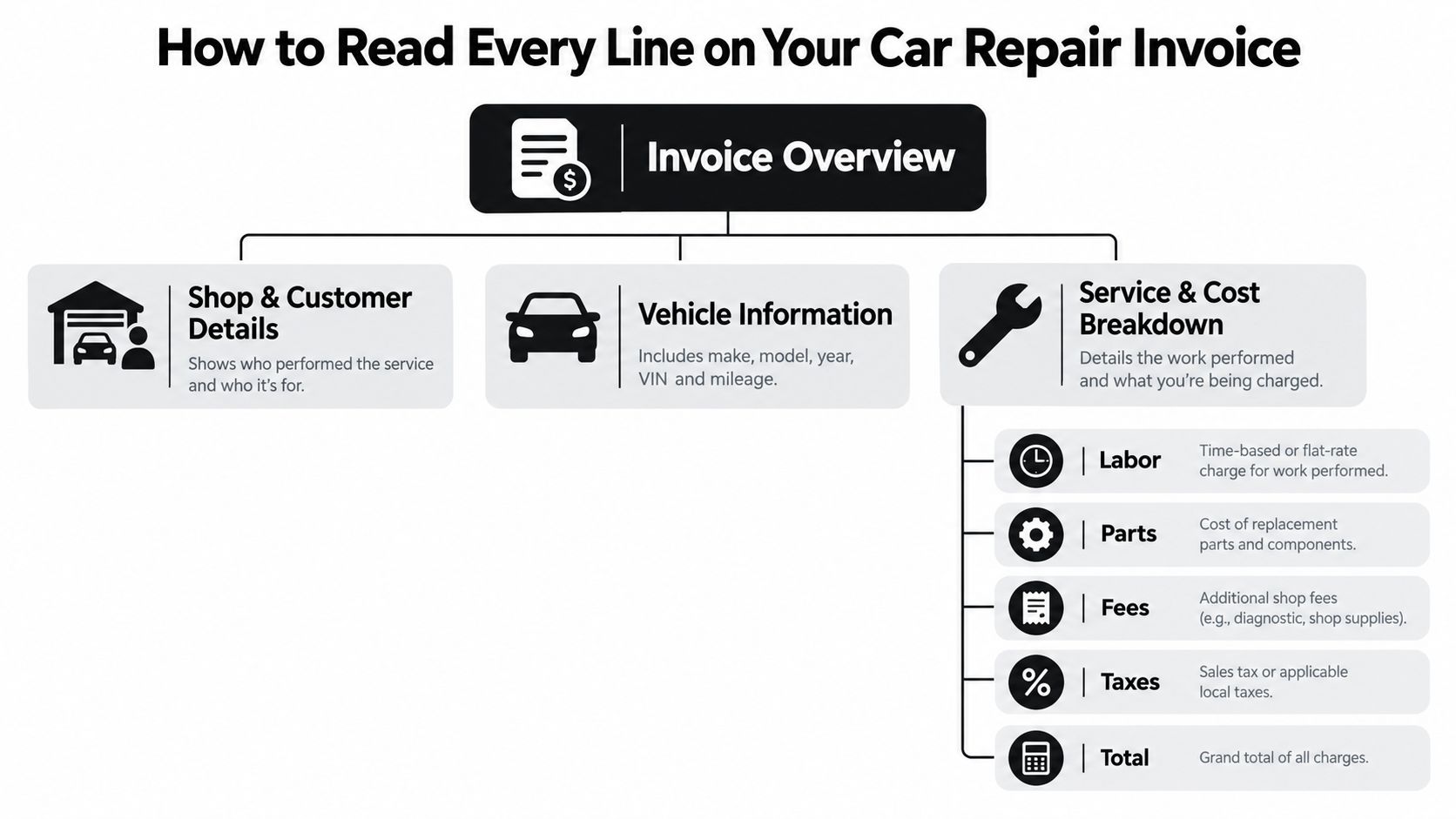
Think of the invoice as a map. The top identifies the people and vehicle involved, the middle describes the route taken, and the bottom shows how the final amount was calculated. Read it from top to bottom instead of jumping straight to the total.
Start with identity and timing
The shop's name and address should appear alongside your name and contact details. Check the vehicle identification information, such as the make, model, licence plate or other identifiers used by the shop, and the vehicle identification number where recorded.
Dates matter because they establish when work was authorized and completed. The invoice should also show the odometer reading, particularly the reading when the vehicle is returned. If your kilometre reading is missing or obviously incorrect, ask for a corrected document before filing it away.
Follow the cost trail
The service description should tell you what the technician inspected, diagnosed, adjusted, repaired, or replaced. Labour needs more than a single unexplained amount. Look for the labour hours or other calculation method and the applicable labour rate.
Parts should be named individually, with the price for each part and whether the part is new, used, or reconditioned. A line such as “engine work, total” gives you no practical way to confirm what was installed. Ontario's guide for auto repair businesses says invoices should list the price of each item individually as well as the total cost.
Fees, shop supplies, disposal charges, and taxes should be separated rather than hidden inside an unexplained package amount. The final section should state the warranty terms for parts and labour. If the invoice says “warranty applies” without explaining the coverage, ask the shop to clarify the wording.
For parts decisions, drivers can also compare the explanation of OEM and aftermarket parts before authorizing a replacement. You don't need to know every technical term. You do need enough information to follow each dollar from the approved work to the final total.
Labour Parts Fees and Taxes Explained in Plain Language
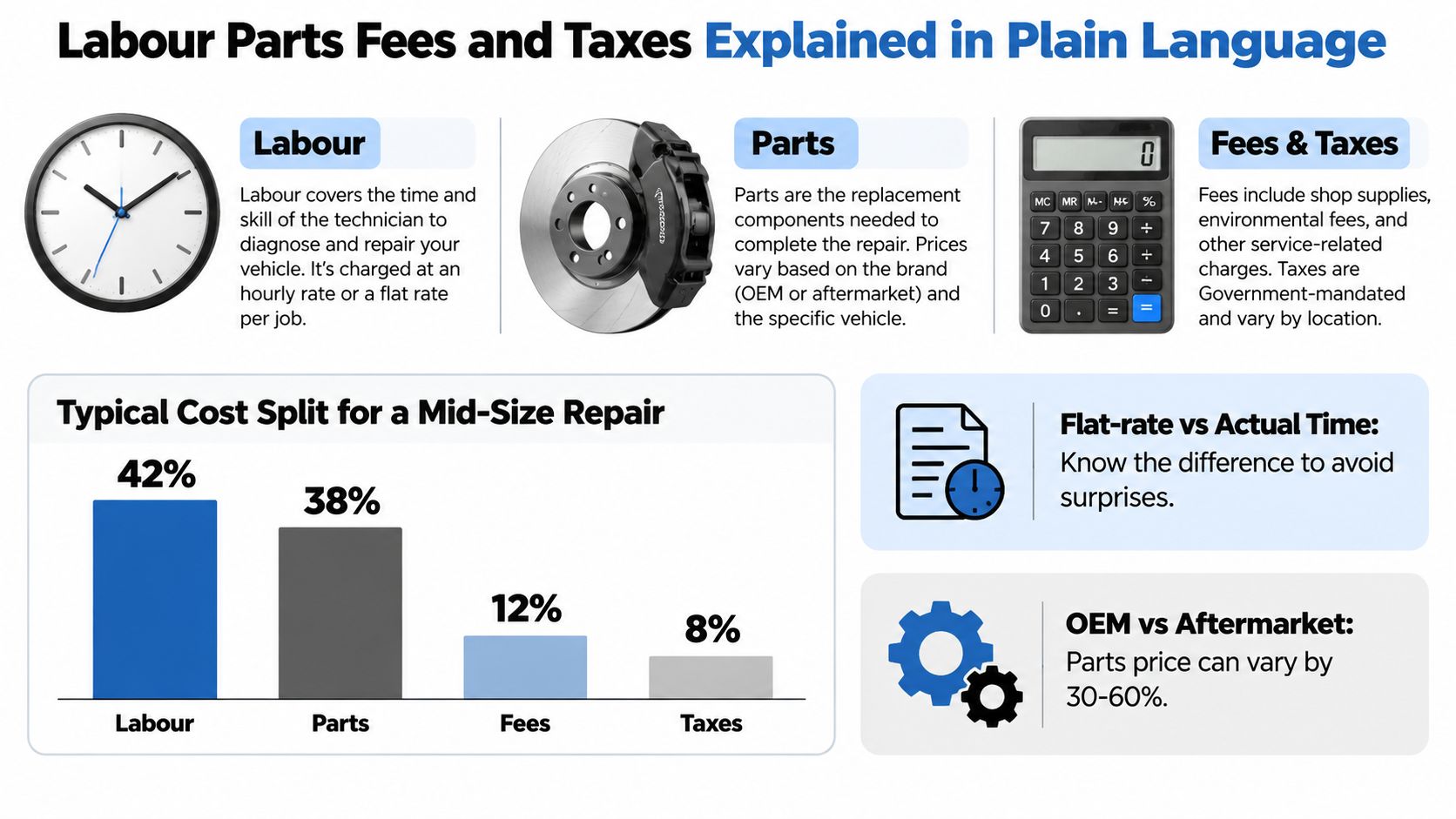
The largest changes on a repair invoice usually come from the interaction between labour, parts, diagnostic work, fees, and tax. One line rarely tells the whole story. A repair that looks small from the outside may require testing before the technician can identify the cause, followed by parts installation and verification.
Labour is a calculation, not just a rate
An invoice may use actual time, a flat-rate or book-time calculation, or another clearly stated method. Actual-time billing reflects the time recorded for the task. Flat-rate billing uses an established time allowance for a repair, so the amount can differ from the clock time the technician spends.
Diagnostic labour deserves its own explanation. A scan or inspection may identify a system that needs attention, but the scan itself isn't always the repair. Ask whether diagnostic time is listed separately, included in the repair labour, or credited toward later work. “Diagnosis and repair” is much less useful than separate descriptions showing what was tested and what was completed.
Ontario shop labour rates reported for 2026 were about $110 to $150 per hour for independent shops in Toronto, Ottawa, and the GTA, while dealership rates were around $150 to $220 per hour. Smaller Ontario towns were typically reported at roughly $95 to $120 per hour. These figures come from Ontario car-repair cost guidance and explain why diagnostic time plus installation can move a bill quickly.
Parts and additional charges need labels
Parts should identify their condition and price. If you're comparing estimates, ask whether the quoted component is OEM, aftermarket, used, or reconditioned, and whether the invoice uses the same category that you approved.
Shop supplies and environmental charges should have a description and amount. Taxes should be shown separately so you can distinguish the repair price from government charges. For drivers looking for a clear discussion of repair pricing, affordable auto repair options can provide a useful comparison point, but every shop should still explain its own invoice.
Ontario Rules That Protect You on Estimates and Invoices
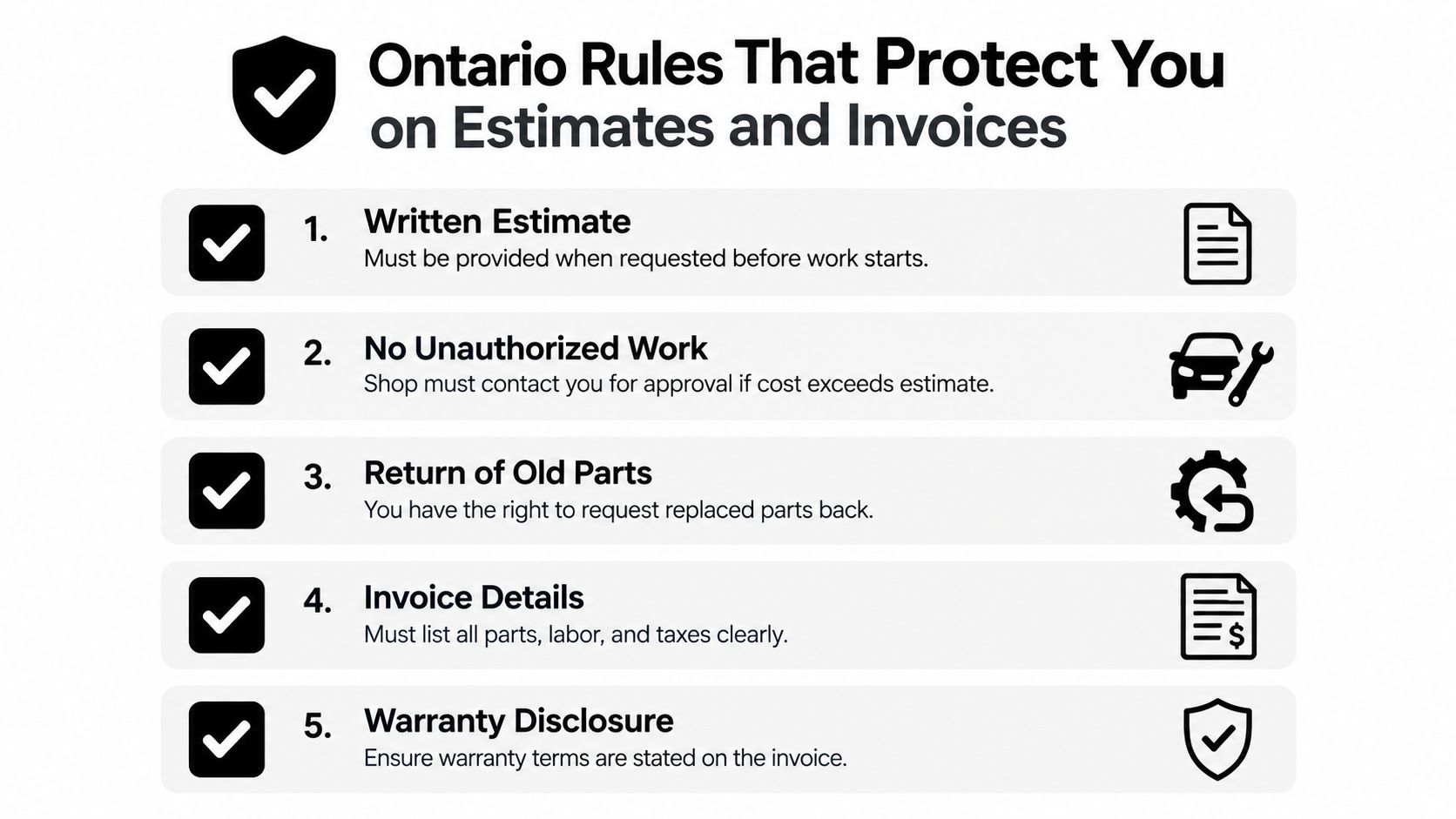
Ontario gives drivers several practical protections before and after repair work. They work best when you ask for the paperwork before authorizing the job and keep every written exchange afterward.
Get the estimate in writing
Under Ontario's Motor Vehicle Repair Act, if you ask for a written estimate, the repairer must provide it in writing before charging for the work. The estimate must identify the customer and repairer, the vehicle, the proposed work, the parts, the condition of those parts, parts prices, labour hours, labour rate, and total estimated amount.
The final bill generally cannot exceed the written estimate by more than 10%, under the Consumer Protection Act rule described in Ontario repair guidance. Disputes often turn on whether the shop documented the estimate clearly and whether the final amount stayed within that cap.
If the shop discovers additional work, ask for the new amount and your approval in writing before proceeding. A text message or email can help establish what you agreed to, but save the full exchange rather than only the final “yes.”
Check the invoice and warranty
Ontario requirements also cover the final invoice. It should include consumer and repairer details, vehicle identifiers, authorization and completion dates, odometer readings, installed parts and their condition, parts prices, labour cost and calculation, and warranty terms, as explained in the province's car repair rights guidance.
The parts-and-labour warranty is 90 days or 5,000 kilometres, according to the Ontario safeguard described in that guidance. Ask how the shop applies the warranty and keep the invoice because the dates, kilometres, and repair description may determine whether a later concern relates to the original work.
Annotated Sample Car Repair Invoice and Common Billing Mistakes
A useful sample doesn't need complicated terminology. It needs enough detail for another person to understand the transaction without calling the shop.
A clean sample
Customer: Jordan Lee, Whitby, Ontario
Repairer: Shop name and address
Vehicle: 2021 Honda Civic, vehicle identifier recorded
Date authorized: Recorded on the invoice
Date completed: Recorded on the invoice
Odometer at return: Recorded on the invoice
Concern: Engine warning light illuminated.
Diagnostic work: Electronic system scan and testing identified a failed ignition component.
Labour: Labour hours or stated calculation method, with the shop's labour rate.
Part: Ignition coil, new aftermarket part, individual price shown.
Additional charge: Shop supplies, individually described and priced.
Taxes: Listed separately.
Total: Final amount calculated from the listed entries.
Warranty: Parts and labour terms stated in plain language.
That format gives the driver a trail from concern to diagnosis, repair, price, and protection. Ontario's rights guidance requires the final invoice to include the core identity, vehicle, timing, parts, labour, and warranty information, so a bill that omits those details deserves a question rather than a silent filing cabinet.
Compare the wording
| Line Item | Good Example | Vague or Risky Example |
|---|---|---|
| Labour | “1.5 hours diagnosis at stated labour rate” | “Labour, total” |
| Parts | “New aftermarket ignition coil, individual price” | “Part” |
| Diagnostic work | “Scan and testing for engine warning light” | “Checked vehicle” |
| Fees | “Shop supplies, described and priced” | “Miscellaneous” |
| Warranty | “Parts and labour warranty terms stated” | “Warranty applies” |
Common warning signs include diagnostic time blended into repair labour, a parts line with no condition, shop supplies without an explanation, and a warranty reference that doesn't say what is covered. If you need to challenge the document, write down the exact line, the question you asked, and the answer you received.
Keep a digital copy of the estimate, invoice, and related messages in one vehicle folder. A simple filename with the vehicle and service date makes the record easier to find when you need it.
How to Verify Dispute and Keep Digital Records Without Stress
Audit the invoice while the details are still fresh. You don't need to accuse anyone. You need to compare documents and ask for missing information calmly.
Use a repeatable audit
Start with the estimate. Compare the approved work, parts category, labour method, and total with the final invoice. Then check the vehicle identifier, authorization date, completion date, and odometer reading.
Next, inspect the cost lines. Confirm that every installed part has a name, condition, and price. Check that labour shows its calculation, diagnostic work isn't added as an unexplained repair amount, and fees are identified rather than bundled into “miscellaneous.”
Finish with warranty terms and taxes. If something is unclear, ask the advisor to correct the invoice or explain the entry in writing. A properly documented invoice should make the conversation easier because both sides can refer to the same line.
Preserve the digital trail
If approval happens by text, save the complete conversation, including the shop's description of the extra work and the amount you approved. For email approvals, retain the original message, attachments, estimate revisions, and timestamps. Don't rely on a screenshot alone if the email thread contains the surrounding context.
Save electronic invoices in their original format when possible, then keep a backup. Ontario's regulation on motor vehicle repairers sets out required invoice information, including authorization and completion dates and the odometer reading at return. Digital delivery doesn't remove the need to check those fields.
A duplicate-looking charge also deserves a separate check against your payment record. General guidance about handling a duplicate charge on a statement can help you separate a payment-processing issue from a genuine duplicate repair line.
Escalate with records
If the shop won't clarify or correct the invoice, make the complaint in writing and keep the response. Ontario guidance indicates that complaints can escalate to the ministry or court, and your invoice, estimate, approvals, photographs, and second-shop assessment may support your position.
For a clearer visual record of vehicle condition, ask about a digital vehicle inspection when that service is available. Photos and inspection notes won't replace an invoice, but they can add useful context to the repair record.
Canadian repair invoices have also become more consequential as repair costs rise. The average repairable auto-insurance claim cost reached $5,044 in the first half of 2023, up 12% from the prior year, according to Statistics Canada-linked repair-cost data. The same source reports average 2023 repair costs of $6,795 for battery-electric vehicles and $5,122 for internal-combustion vehicles, a difference of $1,673, or roughly 32.6% higher for EVs. Clear records matter when a repair carries a substantial financial consequence.
Avoid Surprises Next Time and Get Help in Whitby
Invoice problems are easier to prevent before the vehicle enters the bay. Ask for the written estimate, confirm what the diagnostic stage includes, and make sure the shop knows how you want additional work approved. A short written message can prevent a long disagreement later.
Before signing or approving, confirm:
- Work scope: What concern is being investigated, and what repair is currently proposed?
- Labour method: Is labour based on actual time, flat-rate time, or another calculation?
- Parts condition: Are the proposed parts new, used, reconditioned, OEM, or aftermarket?
- Extra work: How will the shop contact you if the diagnosis changes?
- Invoice content: Will the final document list parts, labour calculation, fees, taxes, odometer, and warranty terms?
- Records: Will you receive the estimate, approvals, inspection notes, and final invoice electronically?
Those questions don't signal distrust. They establish a shared plan. They also help you compare shops fairly, since a low initial total may not be comparable if one estimate includes diagnostic work and another does not.
A dealership visit and an independent-shop visit may also produce different totals. A 2024 J.D. Power study cited in the Canadian repair-cost material found average dealership service visits of $465 and independent-shop visits of $273, a difference of $192 per visit. Those figures are context, not a substitute for reviewing the actual work, parts, labour, and warranty on your vehicle's invoice.
If you're comparing local providers, use a practical checklist for finding the best car repair shop near you. Look for a shop that will explain the estimate, document approvals, answer questions about parts, and provide an itemized final invoice.
Carmedics Autowerks Inc offers general auto repairs, diagnostics, fleet maintenance, collision repair, window tinting, and paint protection film services in Whitby. For a repair estimate or a second opinion, bring your current invoice and approval messages so the team can review the paperwork alongside the vehicle.
Carmedics Autowerks Inc can help Whitby drivers with diagnostics, general repairs, collision work, and clear service documentation. Visit Carmedics Autowerks Inc to request service, discuss an estimate, or arrange a second look at an invoice that doesn't make sense.