

You've just picked up a new vehicle in Whitby. The paint is flawless, the dealer plates are still on, and the first serious drive may be a daily run along the 401 or QEW through winter road spray. By spring, the front bumper, hood, mirrors, and lower fenders may be facing stone chips, gravel, salt abrasion, bug residue, and road grime.
That's why Canadian owners ask, is full PPF worth it? The answer isn't about shine. It's about how much highway exposure the vehicle gets, how long you'll keep it, how much you value factory paint, and whether you'd rather prevent damage than repair it later.
| Protection choice | Best fit | Main strength | Main limitation |
|---|---|---|---|
| Full PPF | New vehicles driven year-round and kept for years | Broad paint protection across painted surfaces | Highest installation cost |
| Partial PPF | Daily drivers focused on front-end impact areas | Protects the most exposed panels | Unprotected panels remain vulnerable |
| Ceramic coating | Owners prioritising gloss and easier washing | Helps with surface appearance and maintenance | Doesn't provide impact protection |
| No protection | Low-mileage or short-term ownership | Lowest upfront cost | Paint faces every road hazard directly |
A practical overview of the benefits of paint protection film can help, but the decision should come down to your ownership pattern, not a sales pitch. For most Whitby and Durham Region drivers, winter exposure and highway kilometres matter more than the vehicle's badge.
Introduction Why Ontario Drivers Ask Is Full PPF Worth It
A new vehicle can lose its factory-fresh appearance during an ordinary Ontario commute. A daily run from Whitby, Ajax, Oshawa, or Bowmanville along the 401 or QEW puts the front end behind trucks, traffic, gravel, and winter road spray. Salt, bugs, repeated washing, and road debris then work against the paint through the season.
The ownership question is practical: how much highway exposure will the vehicle receive, how long will you keep it, and what will a clean factory finish be worth at trade-in? Ontario-focused service information identifies PPF as a barrier against stone chips, road debris, gravel, winter salt abrasion, bug etching, and micro-scratches. The Ontario-focused PPF service information also states that quality films are commonly warranted for 5 to 10 years. That warranty range matters only if it matches your keep-time.
Practical rule: Full PPF makes the most sense when the vehicle is new, the routes are exposed, and you plan to keep it through repeated Ontario seasons.
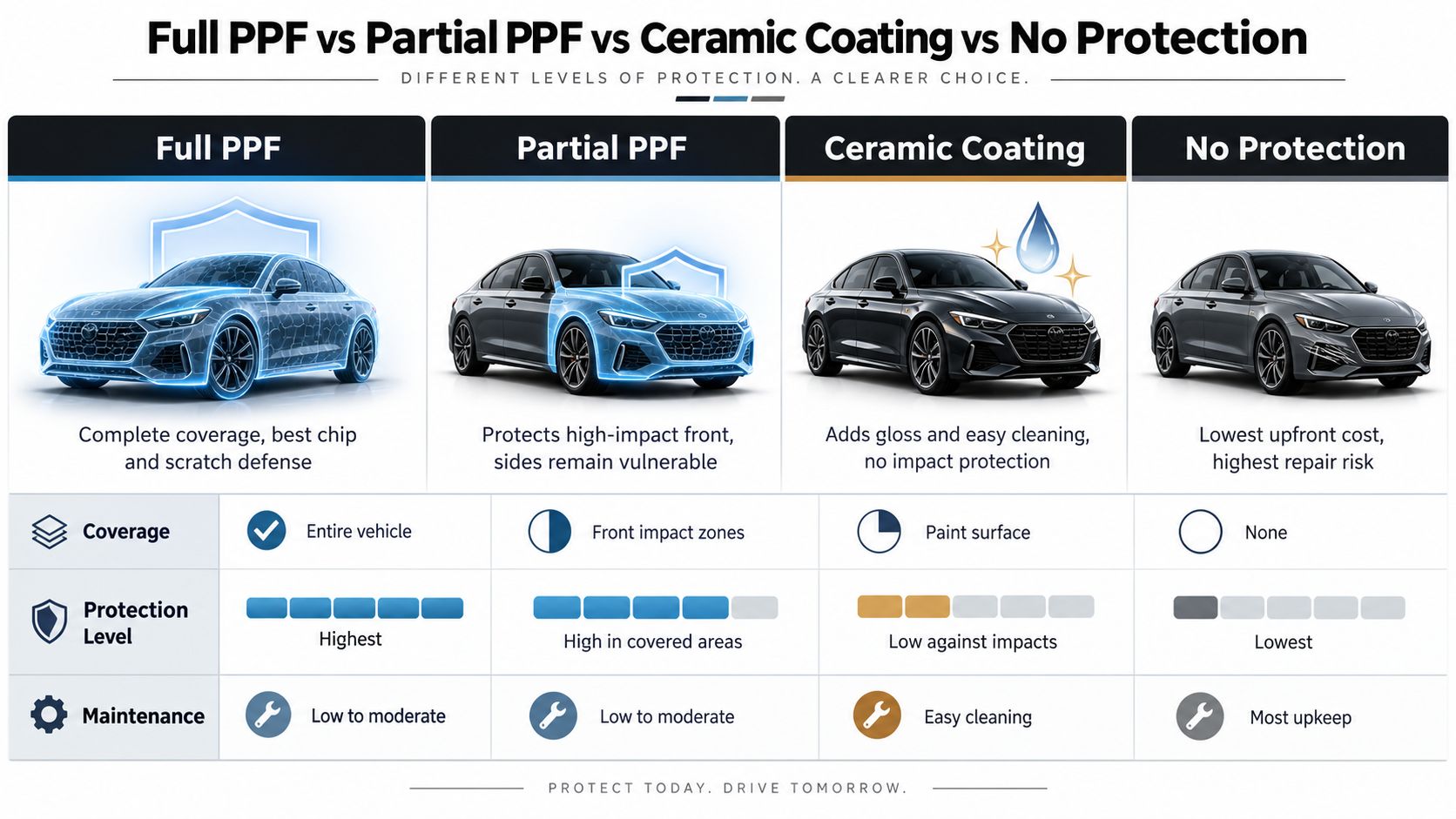
The four choices serve different ownership patterns. Full PPF covers every painted surface. Partial PPF focuses on the front or other high-impact areas. Ceramic coating can improve gloss and make washing easier, but it does not shield paint from stones. No protection has the lowest upfront cost, while every chip, stain, and scratch reaches the finish directly.
Full PPF is not an automatic choice for a mainstream vehicle under about C$40,000, especially when the planned ownership period is only 3 to 5 years. Those owners may spend more on film than they recover through avoided chip repairs, repainting, or a stronger trade-in appraisal. The benefits of paint protection film provide useful context, but the break-even point depends on the vehicle, routes, condition, and keep-time.
The decision becomes easier when the math is specific. Choose full coverage when protecting original paint through winter and highway use matters enough to justify the installation cost. Choose partial coverage or no film when exposure, vehicle value, or ownership time is limited.
What Full PPF Actually Protects and How It Works
Paint protection film is a clear urethane barrier installed over painted panels. It's designed to take the abuse that would otherwise reach the vehicle's paint. When a stone hits the film, the film absorbs and distributes part of that impact instead of leaving the paint exposed.
Full coverage means the installer protects all painted exterior surfaces, not only the bumper and hood. Depending on the vehicle and package, that can include the doors, rear quarters, roof, trunk or liftgate, fenders, mirrors, and other painted sections. The important distinction is scope. A partial installation protects selected impact zones, while a full installation protects the vehicle's painted finish as a complete system.
The hazards PPF is built to handle
3M Canada describes Scotchgard Pro Series 4.0 as protection against stone chips, scratches, bug damage, road tar stains, automotive fluid stains, and outdoor weathering, including harsh UV radiation. The product information for Scotchgard Pro Series 4.0 also describes durability and resistance to yellowing and cracking.
That list fits Ontario ownership. Highway debris attacks the front and side surfaces. Gravel and salt create abrasion. Bugs and road tar leave contaminants that can stain or etch exposed paint. UV exposure can affect long-term finish appearance, although PPF shouldn't be presented as a cure for every kind of vehicle damage.
The film is sacrificial. It isn't indestructible, and it doesn't eliminate the need for careful washing. It gives the paint a replaceable protective layer, which is very different from applying a product that only changes surface behaviour.
For readers also preparing for Ontario driving, G1 practice exam support is a useful resource for reviewing licensing questions before spending more time on the road.
Why material construction matters
3M Canada lists its heavy-duty Scotchgard PPF SGH12 as a 12-mil clear film designed to protect against stone chips, abrasion, and weathering, and says it meets automotive OEM specifications. The Canadian SGH12 product information gives buyers a tangible way to distinguish a purpose-built automotive film from a thin decorative covering.
Full PPF is therefore a physical protection decision. If you want to understand the specific relationship between film and stone damage, review how PPF protects against rock chips. The useful question isn't whether film makes a vehicle invulnerable. It's whether the areas you care about face enough exposure to justify putting a barrier over them.
Full PPF Versus Partial PPF Versus Ceramic Coating Versus No Protection
The cleanest comparison uses the same criteria for every option. Ask what each choice protects against, what it leaves exposed, and how closely it matches your driving.
| Criteria | Full PPF | Partial PPF | Ceramic Coating | No Protection |
|---|---|---|---|---|
| Stone-chip defence | Broad protection across painted surfaces | Stronger protection in selected areas | No impact barrier | None |
| Salt and gravel abrasion | Protects covered paint from direct exposure | Covered panels only | Doesn't stop physical impact | Paint takes the exposure |
| Bug and tar staining | Film is engineered to resist listed stains | Same benefit where installed | Can help cleaning, but isn't a physical shield | Contaminants contact paint |
| UV and weathering | Adds a protective layer against listed weathering | Limited to covered areas | Primarily an appearance and maintenance treatment | Finish faces weather directly |
| Gloss retention | Preserves the covered finish beneath the film | Preserves selected panels | Enhances gloss and surface slickness | Depends on paint condition and care |
| Maintenance | Requires proper washing and inspection | Similar care on covered areas | Usually chosen for easier cleaning | Regular cleaning still matters |
| Coverage gap | Minimal when installed over all painted surfaces | Unprotected panels remain visible and exposed | Entire exterior may be treated, but without impact protection | No coverage |
| Ownership fit | Long-term, high-exposure ownership | Focused protection with a lower commitment | Appearance-focused ownership | Short-term or low-exposure use |
Full PPF
Full PPF is the strongest choice when your priority is keeping factory paint intact across the whole vehicle. It's especially defensible for a new SUV, EV, performance car, or daily commuter that sees highways and winter roads.
The drawback is straightforward. You're paying to cover panels that may not receive the same impact as the front end. If your vehicle rarely leaves town, spends most of its time in a garage, or will be sold quickly, the extra coverage may not return enough practical value.
Partial PPF
Partial PPF is the sensible middle ground for many drivers. It targets the front end and other areas most likely to meet stones and road debris, while avoiding the cost of full-body coverage.
The trade-off is permanent exposure elsewhere. Doors, rear quarters, roof sections, and other painted panels can still collect scratches, stains, and environmental wear. Partial coverage works best when you want to reduce front-end damage rather than preserve the entire finish.
Ceramic coating
Ceramic coating belongs in a different category. It can improve gloss, help water and dirt release from the surface, and make routine cleaning more convenient. It doesn't provide the urethane impact barrier that PPF provides.
That makes coating a strong appearance and maintenance choice, but a weak substitute for film on a highway-driven vehicle. You can also choose coating for areas that don't need stone-chip protection, but that decision should be made with a clear understanding of what the product can and can't do. The PPF versus ceramic coating comparison is useful when your priority sits between finish appearance and physical protection.
No protection
No protection is rational when the vehicle is low-mileage, lightly exposed, or owned for a short period. It's also reasonable if you accept that the finish will show use and don't plan to spend money preventing every mark.
It's not the lowest-risk choice. It's the lowest upfront commitment. In Ontario, that means salt, gravel, bugs, road tar, and UV exposure reach the paint without a sacrificial layer.
How Much Full PPF Costs and When It Pays Back in Ontario
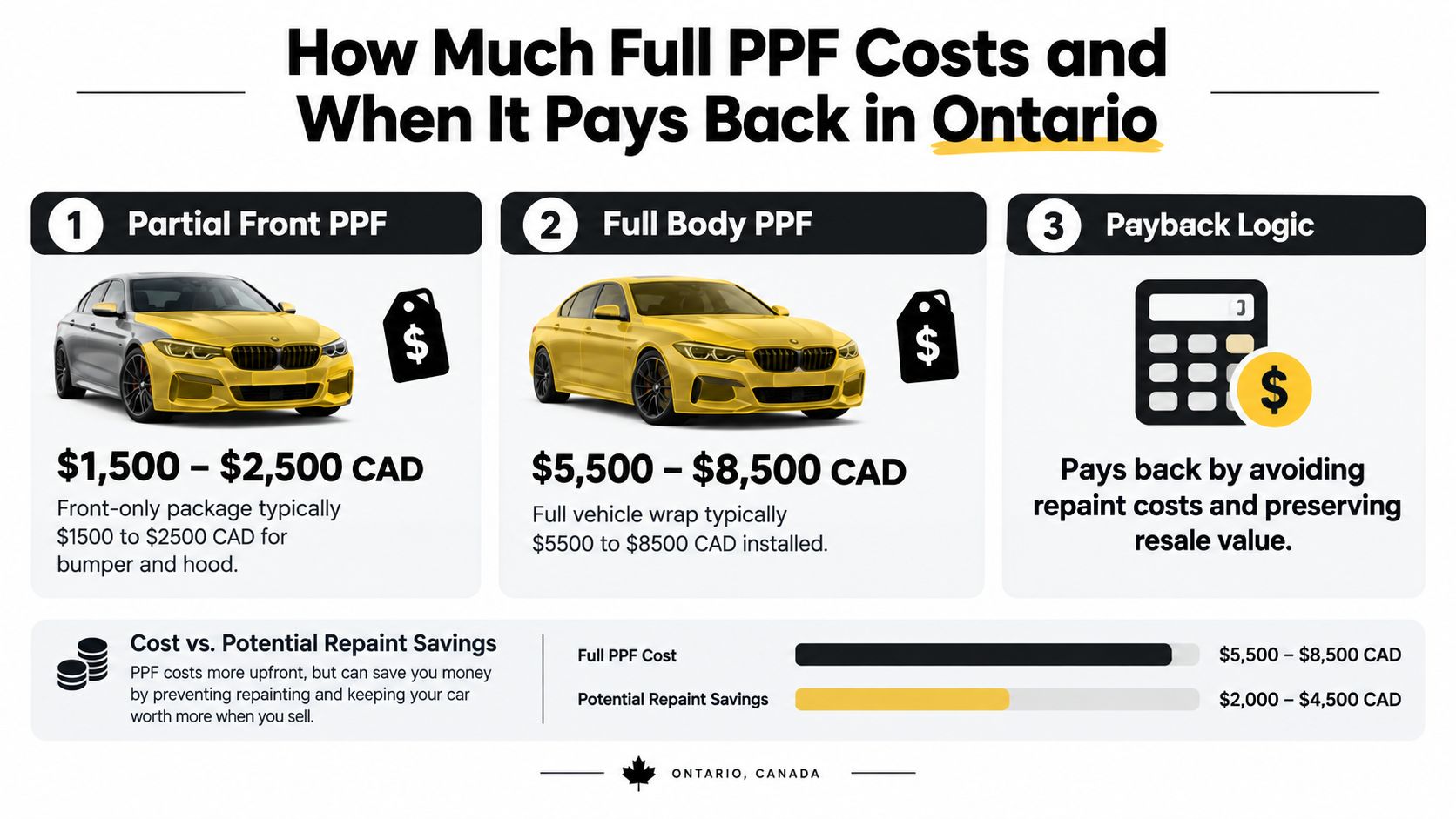
Full PPF only makes financial sense when the protection matches how you drive and how long you will keep the vehicle. Installation cost is the starting point, not the payback calculation. Canadian pricing guidance places partial packages around C$300 to C$2,500 and full-front protection around C$1,500 to C$2,500, but an Ontario quote depends on the vehicle and the scope of work. Carmedics Autowerks' explanation of how much PPF costs is a useful pricing reference before requesting a vehicle-specific assessment.
Panel size, paint condition, film specification, coverage, installation complexity, and preparation all change the final figure. Full-body film costs more because the installer must prepare and cover substantially more painted area. A clean, well-prepared installation also matters at trade-in time, since poor edges or existing paint defects can reduce the visual benefit.
Match the warranty to your keep-time
3M Canada lists a 10-year warranty for Scotchgard Paint Protection Film Pro Series, a 7-year warranty for standard Scotchgard Paint Protection Film, and a 5-year warranty for Surface Protection Film. 3M Canada's Scotchgard warranty programme identifies those coverage periods for material and manufacturing defects, including yellowing, bubbling, and cracking.
Use the warranty as a planning reference, not a promise that every road mark or installation problem will be covered. Compare that support window with the period you expect to own the vehicle. If you plan to sell before the film's value has had time to offset repeated highway exposure, full coverage is harder to justify.
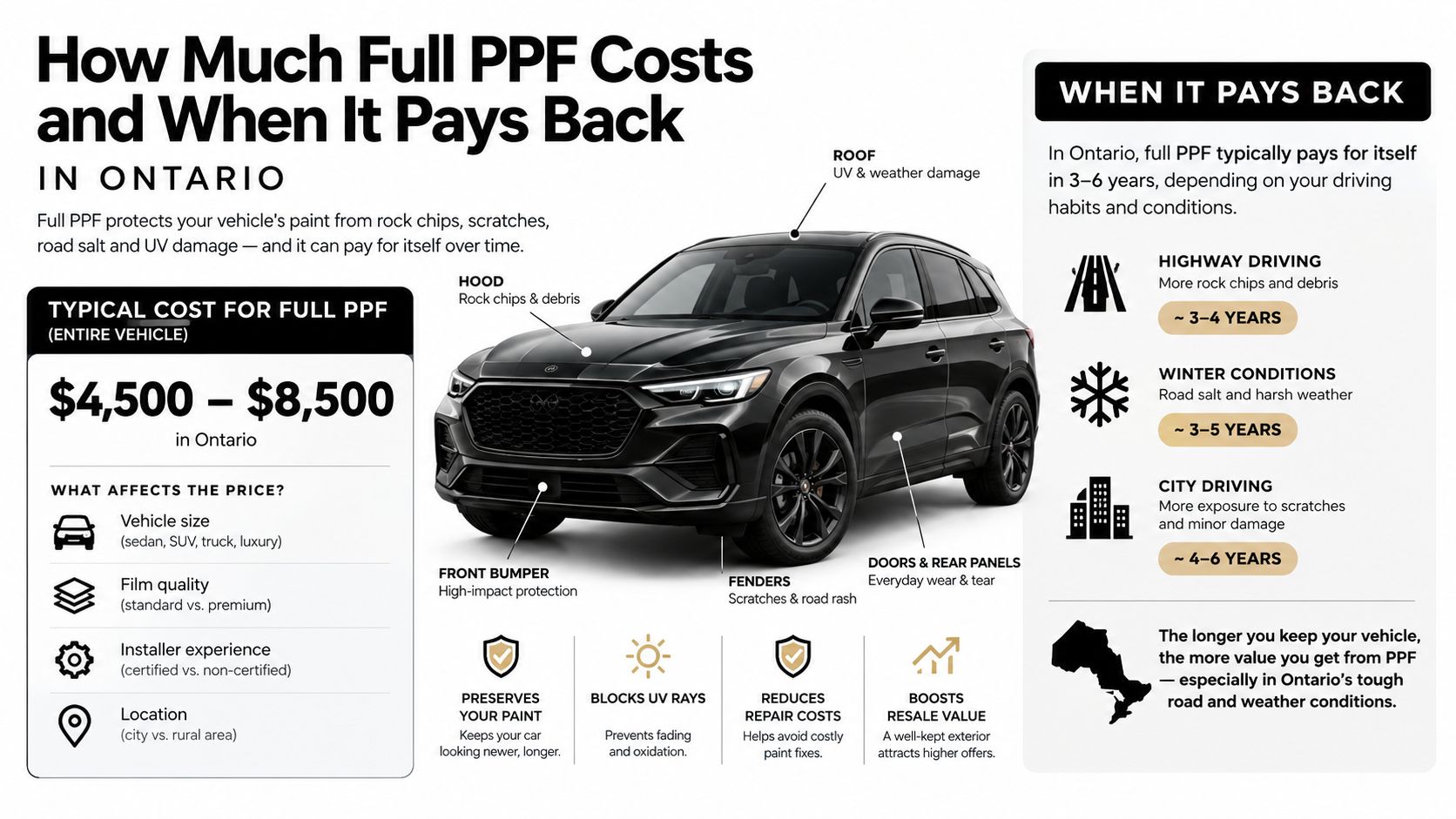
For a mainstream vehicle under about C$40,000, calculate the decision against your actual Ontario use:
- Highway exposure: Frequent 401, QEW, or gravel-route driving raises the chance of front-end chips.
- Repair threshold: Decide whether you would repaint a chipped hood or bumper before selling.
- Trade-in condition: Ask whether visible chips and cosmetic wear could affect the appraisal.
- Keep-time: A longer ownership period gives the film more winters and highway kilometres to protect.
- Coverage scope: Partial front protection may address the highest-risk panels at a lower commitment.
Do not treat resale value as guaranteed repayment. Preserved paint can support a cleaner presentation and reduce the temptation to pay for cosmetic repairs, but any appraisal benefit depends on the vehicle, buyer, and condition.
Include PPF in the wider ownership budget, especially when comparing an EV with a conventional vehicle. The Solana EV cost breakdown provides a broader way to review ownership costs. For a Whitby driver, full PPF pays back most clearly when winter salt, 401 debris, and a planned long keep-time make avoided repainting and preserved appearance more valuable than the upfront installation cost.
Durability Maintenance and Appearance Over Ontario Winters
Full PPF earns its cost only when it stays properly installed and maintained. Ontario winter raises the maintenance requirement. Salt, gravel, road spray, bugs, and fine scratches will test the film every day, especially on a vehicle that sees the 401 through Whitby and Durham Region.
Wash the vehicle with suitable automotive products, use gentle contact, and remove salt and road film before they remain on the surface for extended periods. PPF is designed to resist common surface hazards, but it is not maintenance-free. Good washing protects the film's appearance and makes its barrier easier to assess over time.
Warranty is part of the durability decision
Quality films are commonly warranted for 5 to 10 years, based on Ontario-market industry information. 3M's Canadian warranty benchmarks list Pro Series at 10 years, standard Scotchgard PPF at 7 years, and Surface Protection Film at 5 years. Match the warranty period to your ownership plan. A Whitby owner keeping a new vehicle through several winters gets more opportunity to recover the installation cost than someone selling soon after purchase.
Warranty coverage for yellowing, bubbling, and cracking applies to material and manufacturing defects under the manufacturer's conditions. It does not cover every impact, installation problem, visible mark, or maintenance mistake. Keep the purchase records and follow the installer's care instructions.
Appearance preservation is more than shine
PPF protects the paint beneath it from chips and staining, while its weathering resistance helps the finish stay consistent. Canadian market summaries claim quality films can block up to 99% of UV rays, but that figure is product-specific and should not be treated as a promise for every film or installation. The Canadian market summary discussing UV performance and market context also estimates the Canadian PPF market at $35.6 million in 2025, projecting $45.0 million by 2030 with a 4.8% CAGR.
The ownership test is straightforward. If winter salt and highway grit would lead you to repaint damaged panels before a trade-in, full PPF has a clearer break-even case. If you want to plan film life against your keep-time, see how long paint protection film lasts.
Real World Scenarios When Full PPF Makes Sense in Whitby and Durham Region
A Whitby commuter who drives the 401 every weekday should seriously consider full PPF on a new vehicle kept for several years. The combination of repeated highway exposure and Ontario winter road conditions affects more than the bumper. Full coverage makes sense when preserving the entire painted finish matters, not only the front impact zone.
A driver who uses the vehicle mainly around town has a different calculation. If most trips stay within Whitby, Brooklin, Oshawa, or Ajax and highway use is occasional, partial-front PPF is often the more rational choice. It addresses the panels that concern you most without asking you to cover every painted surface.
For most ordinary new-car owners, full front coverage is the first serious protection tier. Full-body coverage is a separate decision about whole-vehicle appearance.
Leased vehicles require a close look at the return condition you want, but don't assume film will automatically create a financial return. If you're leasing for a short period and your driving is light, ceramic coating or partial PPF may offer a better balance. If the lease sees heavy highway use and you want to avoid obvious chips at return, partial front protection deserves priority.
High-value and enthusiast vehicles are easier to justify. Owners often care about factory paint, consistent colour across panels, and avoiding visible repair history. Matte or unusual finishes can also make the appearance decision more sensitive, but the right product and warranty still need to be confirmed for the specific paint system.
Family SUVs kept for the long term are strong candidates when they travel highways, carry children, and face year-round use. Full PPF protects more of the visible exterior from the gradual accumulation of road wear. It's particularly sensible when the owner wants the vehicle to look cared for at trade-in rather than accept years of cosmetic deterioration.
Low-mileage city drivers don't need to follow the same recommendation. If the vehicle is stored indoors, rarely sees highways, and will be replaced soon, ceramic coating or no protection may be entirely reasonable. Spend the money where the vehicle faces risk.
Final Recommendation and Next Steps With Carmedics Autowerks
So, is full PPF worth it for Canadian drivers today? For a new vehicle driven regularly on Ontario highways through winter and kept for several years, my recommendation is yes. The film protects every painted surface, and that broader coverage matches the exposure better than a front-only solution.
Choose partial PPF when your budget is limited, your driving is mixed, or your main concern is chips on the front end. Choose ceramic coating when gloss, easier cleaning, and surface presentation matter more than impact protection. Choose no protection when you accept normal wear, drive lightly, or won't keep the vehicle long enough to benefit from a multi-season barrier.
Before committing to full coverage, inspect the paint, confirm exactly which panels are included, review the film warranty, and compare the quote with your ownership plan. A new vehicle with clean paint is the best starting point. Once chips and corrosion begin, PPF becomes prevention after the fact rather than protection from day one.
Carmedics Autowerks Inc offers PPF installation for Whitby drivers, including a Full Vehicle package covering painted surfaces and a Full Front package covering the hood, fenders, bumper, and mirrors. Ask for a recommendation based on your route, winter use, vehicle value, and expected keep-time, not the largest package.
If you're driving a new vehicle through Whitby, Durham Region, or Ontario highways, contact Carmedics Autowerks Inc for a vehicle-specific PPF assessment and coverage recommendation. Visit Carmedics Autowerks Inc to discuss full vehicle, full front, or complementary protection options before winter road damage starts.