


You're leaving the Walmart parking lot on Baldwin Street when you see it. The Civic's driver door has taken a hard hit, the mirror is hanging, and the gap beside the rear quarter looks wrong. Or perhaps the damage happened during a rushed 401 merge, followed by a body shop call that sounds simple until the technician says, “We can repair it, but replacement may be the safer route.”
That decision isn't really about a painted panel. A modern door carries the latch, hinges, glass system, intrusion protection, wiring, seals, and sometimes sensors tied to occupant safety. In Canada, inspection guidance expects doors, latches, hinges, and seals to function as intended, and a vehicle can fail when a door binds, jams, won't close properly, or has damaged retention hardware (Canadian vehicle inspection structural integrity guidance). For Whitby drivers, the right question is whether the repaired assembly can reliably protect occupants, shed water, seal against wind, and close with factory geometry.
When a Car Door Has to Be Replaced Instead of Repaired
The first clue usually appears before the estimate. The door may still open, but it swings crookedly, the window drops and refuses to seat, or the upper gap narrows while the lower edge flares away from the rocker. After a rainy drive, water may collect in the footwell. Those symptoms point to movement deeper than a scratched outer skin.
A shallow parking-lot dent in a Civic or Corolla can often be repaired cleanly. A door with deep intrusion into its inner shell is different. If the hinge pillar or latch post has moved, if the side-impact beam has folded, or if the inner structure has stretched around the impact, pulling the outer skin back into shape may leave the door looking acceptable while its crash behaviour remains compromised.
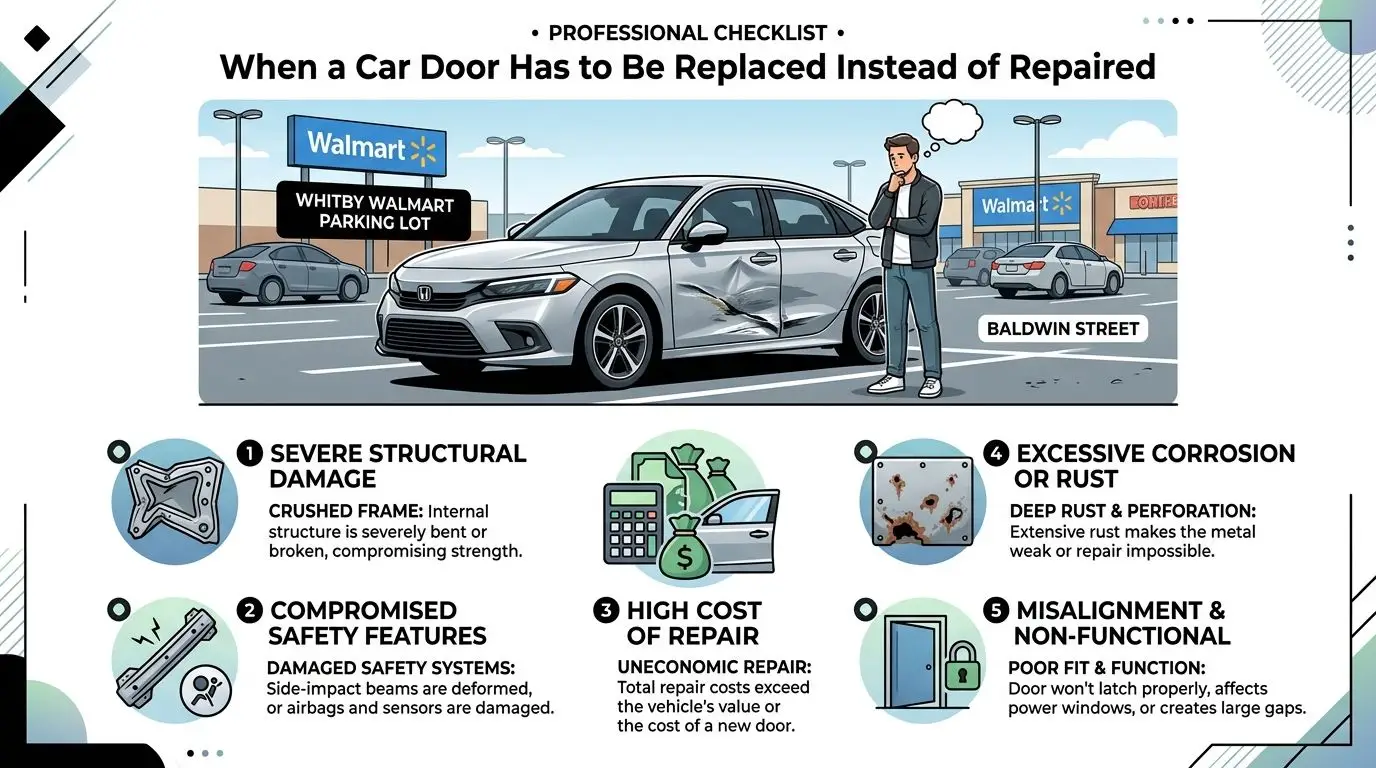
What makes a repair a bad bargain
A technician looks beyond the dent and asks whether the original load paths can be restored. Excessive heat around high-strength steel can alter its properties. An aluminium shell can crack or distort during aggressive straightening. A welded section on a structural area may also create a visible repair history that affects future buyers, particularly on an enthusiast vehicle where panel originality matters.
The latch deserves special attention. Transport Canada's vehicle safety regulations include requirements for door locks and retention components, so a door that needs force to close, bounces off the striker, or releases inconsistently isn't ready for paint or delivery (Motor Vehicle Safety Regulations).
Practical rule: If the hinges, latch mounting area, intrusion beam, or inner shell has lost its original geometry, replacement is usually the more controlled repair.
A written-off vehicle isn't automatically a lost cause
A severely damaged door can form part of a broader insurance assessment. Drivers who want more context on how insurers classify damaged vehicles can review this guide to write-off categories, but the shop still has to prove that the repair is safe and complete. A replacement decision should be supported by photographs, teardown notes, measurements, and a clear explanation of why straightening would not preserve the original structure.
For lighter damage, professional dent removal near Whitby may be the correct answer. The mistake is treating every dent as a candidate for the same process. A clean outer-panel repair works when the inner structure, hinges, latch, glass frame, and seals remain sound. It does not work when the door has become a misaligned safety assembly.
How Technicians Decide Between Repair and Replacement
A proper decision starts with geometry, not the paint colour. The technician checks the door while it's still fitted to the vehicle, then removes trim where necessary to inspect the components an outside visual inspection can't reveal.
The bench and vehicle checks
First, the technician checks hinge and check-strap play. A loose hinge pin or shifted hinge mount changes the door's axis, so pulling the shell won't restore consistent alignment. The latch and striker come next. The latch is cycled, the striker is checked for distortion, and the door is closed repeatedly to identify binding, excess effort, or inconsistent engagement.
Panel gaps are compared at the fender, roofline, rocker, and rear quarter. A gap that changes sharply along its length suggests a bent shell or displaced mounting point rather than a simple outer-skin dent. A hose test around the weatherstrip and drain-rail area then checks for water entry, while the intrusion zone is inspected for kinks, buckling, or signs of previous repair.
Paint thickness can expose hidden history. A high reading around a weld or intrusion zone may indicate filler beneath the finish, but the tool reading must be interpreted alongside visual and structural inspection. No single meter reading should replace an experienced teardown.
| Diagnostic Test | Repair Likely | Replace Required |
|---|---|---|
| Hinge movement | Hinges remain tight and the axis is stable | Hinge mounts or pins have shifted |
| Latch engagement | Latch closes smoothly and holds securely | Latch area or striker geometry is distorted |
| Panel gaps | Gaps remain even after adjustment | Gaps change sharply or cannot be aligned |
| Water-leak test | Weatherstrip and drains remain effective | Inner shell or frame allows persistent entry |
| Intrusion structure | Beam and inner shell are straight | Beam or inner shell is folded or compromised |
| Paint-thickness review | No evidence of major filler or prior structural work | Heavy repair evidence appears in a critical zone |
A technician may also need a frame measurement when the impact has travelled into the pillar, rocker, or quarter panel. That's where frame straightening service information becomes relevant. The door can be perfectly usable on the bench and still fail to align because the vehicle body behind it has moved.
The best estimate explains the failed test. “Needs a door” is weak documentation. “Latch mounting area distorted, hinge geometry outside adjustment range, and inner beam damaged” gives the adjuster and vehicle owner a defensible reason for replacement.
Inside the Door Replacement Process at a Collision Shop
Door replacement is controlled disassembly followed by controlled reassembly. The visible shell is only one part of the job, and most of the labour goes into transferring, checking, and setting up the systems attached to it.
Teardown and pre-fit
The bay starts by isolating the battery where the vehicle's procedures require it, then scanning the door module with the appropriate factory diagnostic equipment. The technician removes the glass, trim, mirror, harnesses, brackets, regulator, latch, handle, vapour barrier, and sound-deadening material. Clips and fasteners are labelled because a missing retainer can create a rattle, water path, or loose trim later.
The replacement shell is test-hung before paint. The technician checks hinge alignment, striker position, rocker clearance, mirror mounting, and the relationship with the A-pillar and rear quarter. Finding a poor-fitting part before refinishing saves a costly strip and repaint.
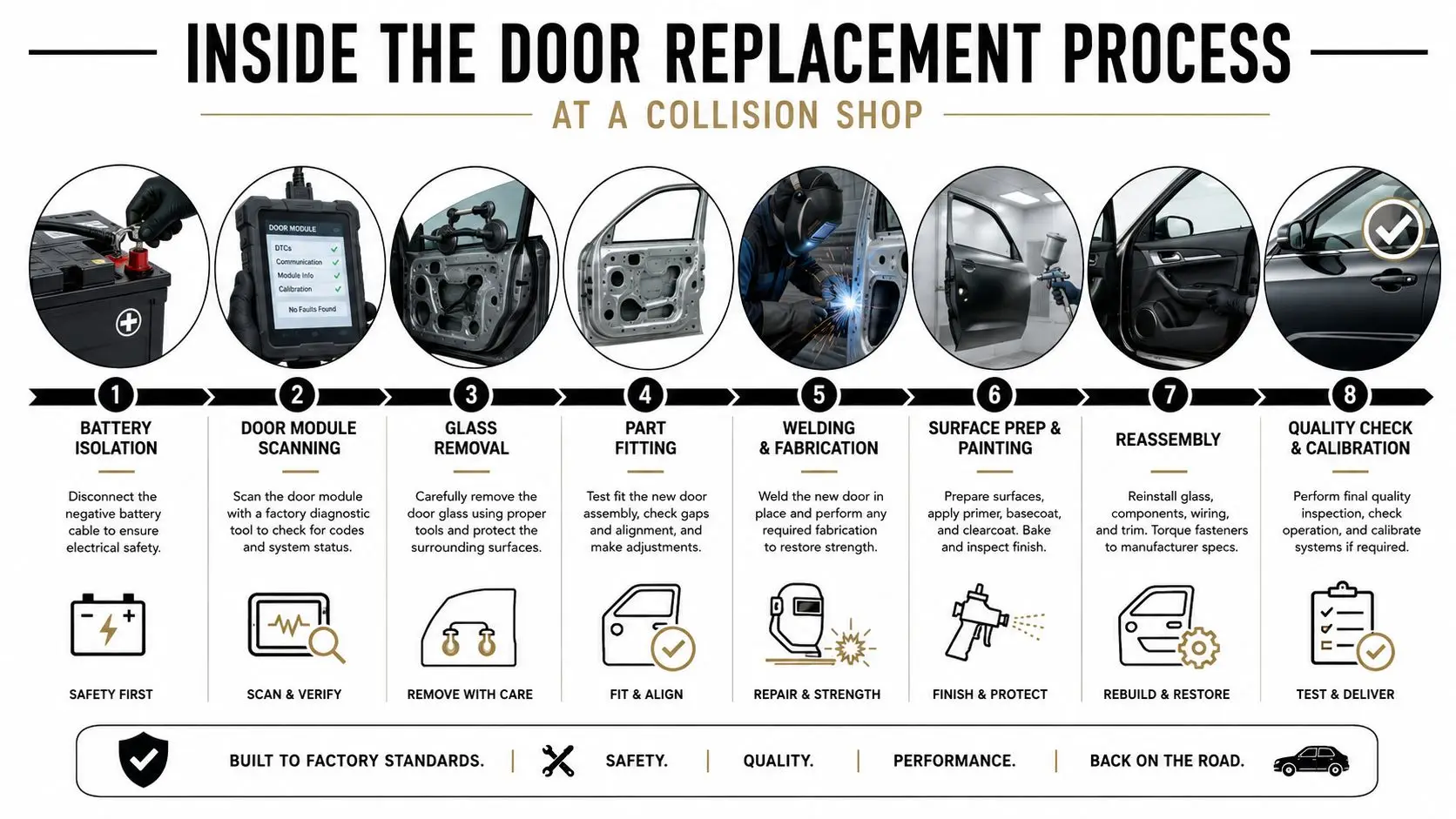
Refinishing and hardware transfer
Once the shell fits, the shop prepares it for colour. A good refinish often requires blending into an adjacent fender, mirror cap, or rear quarter because an aged vehicle's surrounding paint may no longer match the original code perfectly. The new finish needs the correct preparation and curing time before hardware is installed.
Hardware transfer is where shortcuts become expensive. The technician reinstalls the sound deadener, vapour barrier, window regulator, glass, latch, exterior handle, wiring, speaker, and mirror. If the donor shell doesn't include the side-impact beam, the correct replacement component must be installed using the manufacturer's approved method. Structural repairs and retention hardware must preserve original properties and follow manufacturer recommendations, as Canadian inspection guidance emphasises.
A door that looks right in the booth can still be wrong at the curb if the glass indexing, latch preload, or seal compression is off.
Final checks include closing effort, panel gaps, glass indexing, lock operation, drain paths, and seal compression. Vehicles equipped with blind-spot monitoring or cameras integrated into the mirror may need calibration after replacement. The road test checks wind noise, water protection, rattles, and whether the door closes without a hard slam.
For a deeper explanation of the wider repair environment, this overview of auto body repair helps put door replacement in context. The important distinction is that replacing the shell is not the finish line. The vehicle must leave with its safety, comfort, and electronic functions verified.
OEM Doors vs Aftermarket and Salvage Options
The part source changes the repair conversation, but it doesn't remove the need for inspection. Three options appear most often in collision estimates: new OEM, certified aftermarket, and recycled salvage.
A new OEM door comes from the vehicle manufacturer's supply chain. It generally offers the most predictable stamping, hinge geometry, reinforcement design, and finish preparation, which matters on a newer BMW M car, an aluminium-bodied model, or a vehicle where the original panel fit is unusually precise. The trade-off is price and availability. A part can be correct on paper and still delay the repair if it's back-ordered.
Certified aftermarket parts can be a sensible choice on a mainstream daily driver. Their dimensions may match the original, and insurers often scrutinise them through established estimating and parts channels. Fit, flange detail, corrosion protection, and paint-film behaviour can still vary, so the shop should test-fit the panel before refinishing.
A salvage door can work well on an older Civic, Corolla, pickup, or work vehicle, especially when the shell is straight and the shop can inspect its hinges, latch, reinforcement, and drain areas. The risk is unknown history. The donor vehicle may have had previous damage, and the part may carry scratches, corrosion, missing hardware, or no meaningful warranty.
| Source | Fit & Finish | Crash Certification | Typical Cost vs OEM | Insurer Acceptance | Lead Time |
|---|---|---|---|---|---|
| New OEM | Most predictable factory match | Manufacturer-specified component | Highest | Usually strongest when justified | Can be delayed by supply |
| Certified aftermarket | Often good, but requires pre-fit inspection | Depends on the part and application | Lower than OEM | Commonly considered when approved | Often readily sourced |
| Salvage | Varies with donor condition | History may be incomplete | Usually lowest | Depends on policy and documentation | Can be quick if locally available |
On a new vehicle or an enthusiast car, chasing OEM can be worthwhile when the door contains complex electronics, unusual materials, or visible design lines that expose a small mismatch. On an older commuter, a properly inspected recycled door with transferred original hardware may provide better value. The choice should be documented, not presented as a vague “equivalent” without explaining what the part includes.
This OEM versus aftermarket parts guide is useful when comparing the practical differences. Ask whether the quoted door includes the shell only or arrives with glass, regulator, latch, trim, mirror, and reinforcement.
Typical Costs and Timeframes for Door Replacement
A door estimate changes with the vehicle, the part source, the damage behind the door, and the finishing required. The shell itself is only one line. Labour can include teardown, hardware transfer, corrosion protection, paint preparation, blending, electronic diagnosis, calibration, alignment, and road testing.
For broader Canadian context, consumer guidance reports typical installed front-door replacement around $2,100 to $6,500 or more in Ontario, while national estimates cluster around $1,800 to $3,416, with Ontario estimates around $1,836 to $3,212 (Canadian window and door consumer guide). Those figures concern home entry-door projects rather than collision door repairs, so they're a useful reminder that material, sizing, finishing, and installation complexity drive the spread. They shouldn't be used as a quote for a vehicle.
What pushes the bill upward
A basic steel door on a common sedan is easier to source and refinish than an aluminium door on a luxury vehicle. A door with a blind-spot sensor, complex harness, frameless glass, premium speaker, or integrated camera takes more care during transfer and testing. Adjacent-panel blending can also be necessary when the new finish would otherwise create a visible colour break.
In Ontario city-level consumer data, one 2026 dataset places averages at roughly $2,975 in Windsor and $3,430 in Hamilton and Oshawa, while broader Toronto and Ottawa guides show replacement projects reaching $30,000 when the scope includes premium builds such as double entry systems, sidelights, custom openings, or whole-frame retrofits (Ontario door replacement cost data). Those are residential figures, not collision-shop pricing, but they illustrate why a bare door slab and a complete framed installation shouldn't be compared as if they're the same job.
Ask for a line-item estimate that separates:
- Part source: New OEM, certified aftermarket, or recycled.
- Included hardware: Glass, regulator, latch, mirror, speaker, trim, and reinforcement.
- Refinish scope: Door-only paint or blending into adjacent panels.
- Diagnostic work: Scanning, programming, and required calibration.
- Quality control: Alignment, leak testing, road testing, and warranty coverage.
A common part may move through the shop quickly. A back-ordered OEM shell, hidden pillar damage, or missing donor hardware can extend the schedule. The written estimate should identify those dependencies instead of promising a pickup date before teardown.
Navigating Insurance and the Ontario Claims Timeline
Report the collision promptly and preserve evidence. Ontario consumer guidance says many claims must be reported within 7 days or as soon as reasonably possible, while many policies set filing windows ranging from 90 days to 12 months, depending on the policy (Ontario insurance consumer guidance). Your policy wording controls, so confirm the deadline with your insurer rather than relying on a general rule.
The claim sequence
Obtain a claim number and record the date, location, direction of travel, and damage. Take wide photographs of the road or parking lot, followed by close images of the door gaps, hinge area, latch, glass, mirror, pillar, and adjacent panels. A police report may matter after a collision on the 401 or Dundas Street, especially when the other driver's information or the circumstances are disputed.
The adjuster reviews the damage at an appraisal facility or at the shop. The first estimate can change after teardown exposes a folded inner shell, damaged wiring, a bent striker, or a failed sensor. The shop should photograph those findings and list each supplement clearly. An unexplained increase gives the adjuster little to approve and leaves the repair plan difficult to defend later.
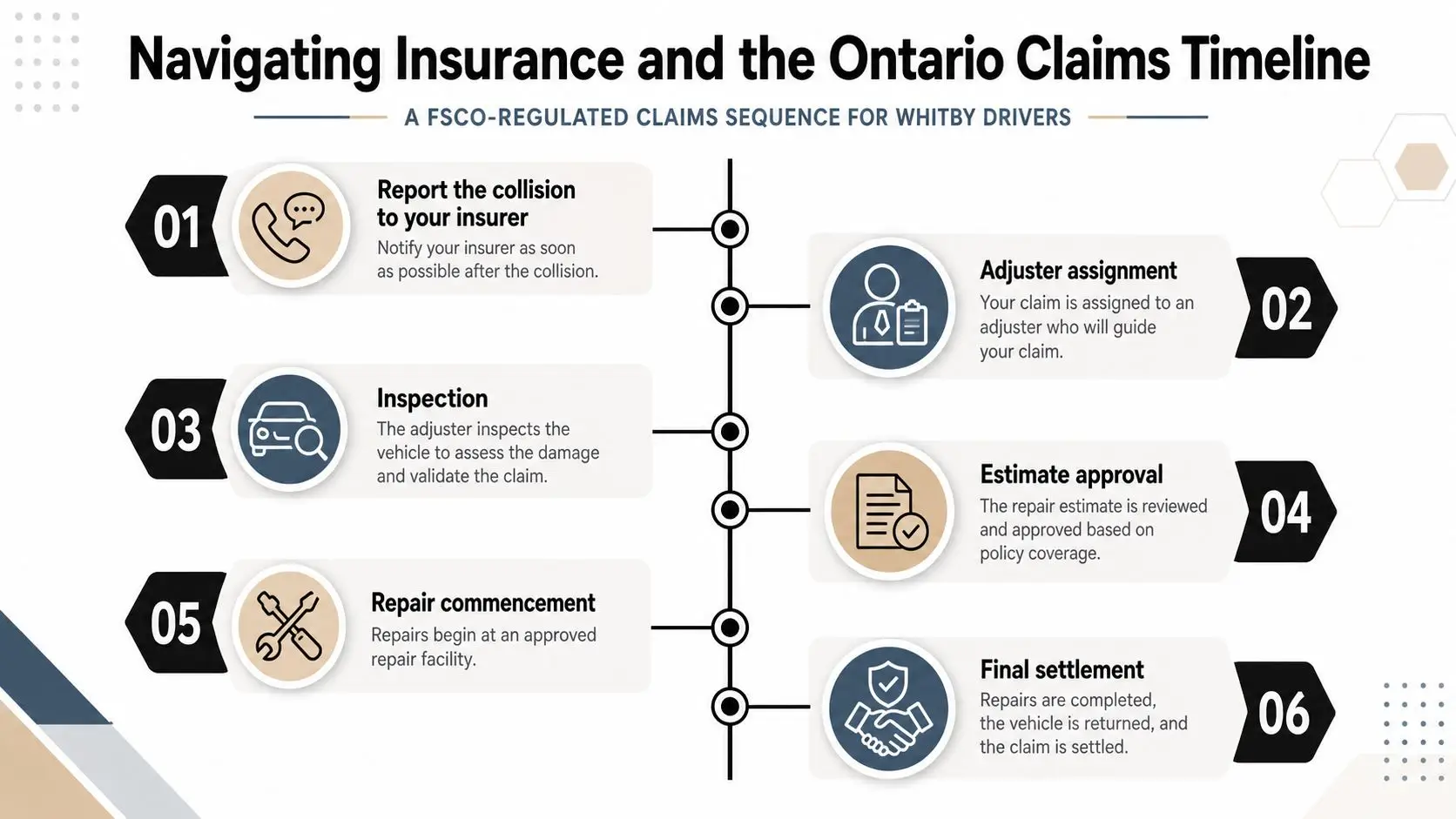
What approval means
Under O. Reg. 277/03, an insurer generally must settle within 60 days after receiving proof of loss when no appraisal is carried out. That settlement rule does not let a shop skip diagnosis or order a major component without authorization. Dated photographs, a complete estimate, and prompt communication keep the paperwork tied to the structural repair.
Ask which repair method is being proposed, where the replacement door comes from, and what supplements remain possible. Ask the insurer about shop choice and direct-compensation coverage as well, since the answer depends on the policy and circumstances. This insurance and car repair resource can help you prepare for that discussion, while the adjuster and policy documents govern the claim.
If the estimate calls for repair but teardown shows that replacement is required, the shop should show the evidence. A deformed latch mount, failed water test, damaged reinforcement, or hinge geometry that cannot be corrected supports replacement more convincingly than appearance alone. It also gives the insurer a clear record of why a safety-related door decision changed after inspection.
How to Choose a Quality Collision Shop in Whitby
A collision shop should be able to explain what it measured, what it replaced, and how it verified the result. A clean reception area is pleasant, but it doesn't prove that the shop knows the welds, adhesives, fasteners, corrosion protection, or diagnostic procedures for your vehicle.
The non-negotiables
Look for current manufacturer certifications relevant to the vehicle in the bay. A Honda, Toyota, or BMW certification can indicate access to specific repair information, tooling, training, and procedural requirements, but ask what the certification covers and whether it applies to the technicians doing the work. Provincial licensing, insurer experience, documented parts traceability, and a written workmanship warranty should also be part of the conversation.
Paint quality reveals process discipline. A controlled booth, proper preparation, correct colour evaluation, and careful blending matter more than a quick spray that looks fine under fluorescent lights. Ask how the shop protects adjacent panels, clears door drains, seals the vapour barrier, and checks for wind noise after delivery.
A capable shop can also coordinate related work such as window tint or paint protection film, which avoids sending the vehicle to multiple facilities. That coordination still needs timing discipline, especially after refinishing, because films and adhesives shouldn't be applied before the paint system is ready.
Questions to take to two estimates
- Ask for the repair method: Will the shop repair, replace, or section the door, and why?
- Confirm the part source: Is it new OEM, certified aftermarket, or recycled, and what does it include?
- Request documentation: Will you receive photographs, measurements, scan results, and supplement notes?
- Read the warranty: Is coverage written, and does it address paint adhesion, corrosion, alignment, leaks, and workmanship?
- Check calibration: Does the estimate identify sensor or camera calibration where applicable?
- Watch for red flags: Avoid vague estimates, verbal-only guarantees, unexplained used parts, and refusal to show repair documentation.
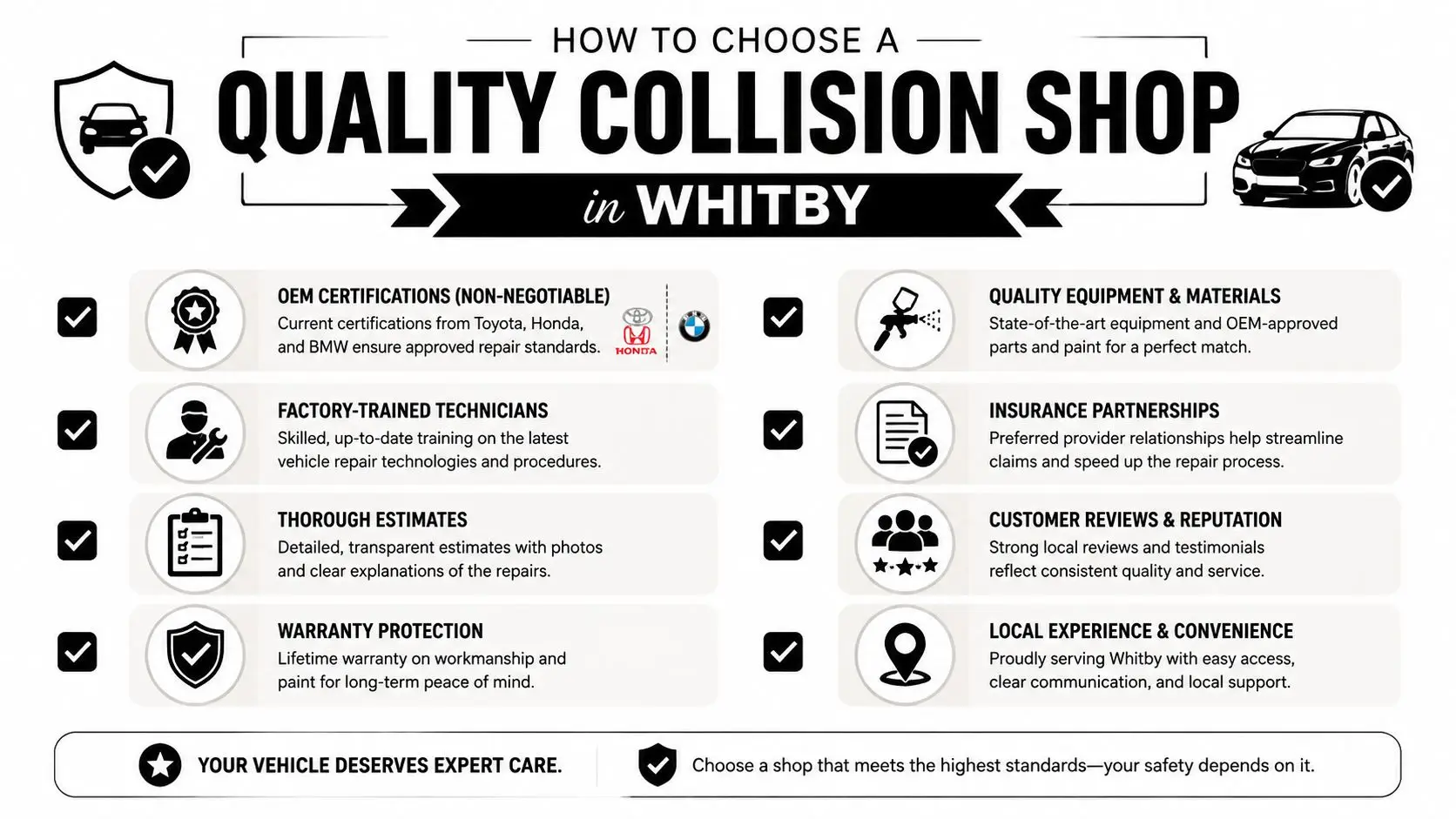
The strongest shop answer is specific. It names the damaged component, the approved repair method, the part source, and the test that proves the door is ready.
Whitby Driver FAQs on Door Replacement
Does winter salt shorten the life of a replacement door?
Salt exposure can accelerate corrosion when drain holes, seams, edges, or cavity protection are neglected. The technician should clear the door drains, restore the correct corrosion protection, and confirm that the vapour barrier and weather seals are seated. A fresh paint finish won't compensate for trapped moisture inside the shell.
When can paint protection film go on the new door?
Don't treat the paint booth exit as the installation date. The refinisher needs to confirm that the paint system has cured sufficiently for the film adhesive and trapped solvents not to create lifting or adhesion problems. Ask the collision shop and PPF installer to agree on the timing based on the actual product system and cure conditions.
Does the dealership have to install the door?
A dealership-only rule doesn't automatically apply. A qualified independent collision shop can handle door replacement when it follows the manufacturer's procedures, uses appropriate equipment, documents the work, and completes any required scan or calibration. The important issue is procedural competence, not the sign above the building.
Can a rusty used OEM door still be used?
Surface scuffing may be manageable, but corrosion at seams, the lower hem, hinge mounts, latch reinforcement, or intrusion structure is a serious concern. A recycled door should be inspected before purchase, and the estimate should identify whether it includes the original hardware or only the shell.
Why doesn't the paint code always match?
Older vehicles spend years in sunlight, road salt, and weather. The original code identifies the intended colour, but the surrounding panels may have faded or changed tone. A skilled refinish technician blends the new colour into adjacent panels rather than forcing a hard line that makes the replacement obvious.
If your Whitby vehicle has a damaged, misaligned, leaking, or unsafe door, Carmedics Autowerks Inc can assess the structure, coordinate insurance documentation, source the appropriate part, and complete collision repair with the required alignment and finishing checks. Visit Carmedics Autowerks Inc to arrange an inspection before a cosmetic-looking repair turns into a safety or water-intrusion problem.