

You've just picked up a new car, or you're staring at the front end of a vehicle you've owned for years, counting the chips across the bonnet. Canadian roads are hard on paint. Highway gravel, construction debris, bug remains, road salt, and winter contamination all find the same vulnerable areas first, especially the bumper, leading edge of the bonnet, mirrors, and front fenders.
The best paint protection film isn't the thickest film or the most recognisable brand. It's the combination of a suitable film, sensible coverage, a competent installation, and warranty conditions you can preserve. Canada's PPF market is estimated at $35.6 million in 2025 and projected to reach $45.0 million by 2030, with a 4.8% CAGR, according to MarketsandMarkets' Canada PPF market data. That growth reflects a practical concern, drivers want to preserve factory paint without paying for unnecessary coverage.
| Canadian driving concern | PPF response | What to prioritise |
|---|---|---|
| Highway gravel and construction zones | Impact-absorbing film | Full front coverage and quality installation |
| Road salt and seasonal contamination | Stain-resistant surface | Easy maintenance and sealed edges |
| Strong sun exposure | UV-stable film | Manufacturer durability data and warranty |
| Winter car washing | Abrasion resistance | Proper edge finishing and careful wash methods |
| Expensive or leased vehicle | Paint preservation | Coverage matched to ownership period |
What Paint Protection Film Does for Your Vehicle
A stone hits the bonnet at highway speed, winter grime sits on the bumper, and road salt works into every exposed mark. Paint protection film, or PPF, is a clear thermoplastic urethane layer that gives those impacts and contaminants a sacrificial surface before they reach the painted panel. For Canadian driving, that means choosing coverage according to repair risk, not just buying the thickest film available.
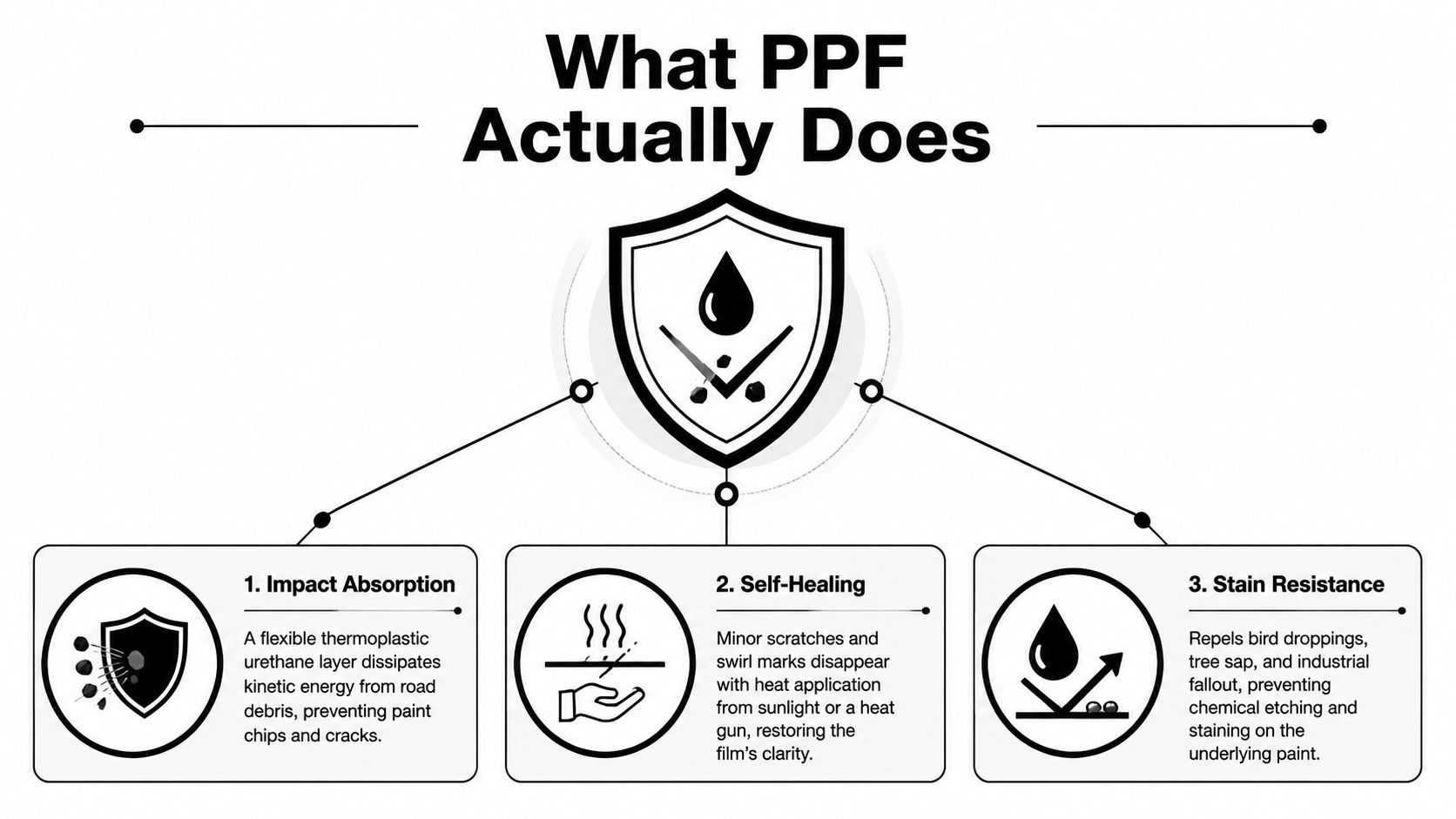
PPF's primary job is impact management. When a stone strikes a protected panel, the film can deform slightly and spread the force across a wider area. That reduces the sharp, localised damage that produces a visible chip. It will not stop every stone, especially at highway speed, and it cannot protect paint from reckless following distances or loose gravel taken aggressively.
Modern film also offers self-healing. Its top layer can recover from light scratches and wash marks when warmed by sunlight or another safe heat source. A deep cut remains, because self-healing restores surface damage, not film that an object has penetrated.
The surface layer affects daily upkeep. A quality top coat resists staining and makes insects, tree sap, road tar, and automotive fluids easier to remove. PPF serves a different purpose from a vinyl wrap, which mainly changes colour or finish, and from a ceramic coating, which improves chemical resistance and water behaviour without providing meaningful impact absorption.
Start with the panels that take the punishment
For most Canadian drivers, begin with the full front:
- Front bumper, where gravel and insects strike directly.
- Full bonnet, rather than only a narrow leading strip.
- Front fenders, particularly around the wheel arches.
- Mirror caps, which face airborne debris and winter contamination.
- Rocker panels, if gravel, salted roads, or poorly maintained routes are part of your routine.
- Door handle cups, where fingernails and rings cause repeated light scratches.
A partial-front package can suit an older daily driver with a tighter budget. It leaves a visible transition and unprotected paint beside the covered area, however. On a new, valuable, or frequently highway-driven vehicle, full-front coverage is easier to justify because it reduces the exposed area most likely to need paint correction or repair. Compare coverage patterns in this paint protection film service overview before approving an installation, and confirm that the installer's certification and warranty terms support the coverage you select.
Practical rule: Protect the panels facing the road first. Add full-body film only after the high-impact zones are properly covered.
PPF prevents many chips and reduces bug-acid etching, but it is not armour. A severe impact, collision, or sharp debris caught on an exposed edge can still damage it. Budget for the risk you face, follow the film maker's care requirements, and treat PPF as a replaceable barrier that preserves factory paint, not permission to ignore distance, cleaning, or winter maintenance.
Comparing PPF Types, Thicknesses, and Manufacturers
The useful comparison starts with the film construction, not the marketing name. Thermoplastic polyurethane, or TPU, is the modern standard because it combines flexibility, optical clarity, and impact resistance. Older polyethylene-based films are generally less elastic and less suited to the complex contours found on current vehicles. Multi-layer coextruded films add a denser top coat over a flexible base, allowing manufacturers to tune gloss, stain resistance, healing behaviour, and handling.
Thickness matters, but thicker doesn't automatically mean better. A properly engineered film in the everyday range can perform better than a poorly made thick film with weak adhesive or poor optical clarity. An 8 mil, or 203 micron, 3M Scotchgard Paint Protection Film Pro Series 96012 is specified by 3M Canada as a thermoplastic polyurethane film with a hard-wearing clear urethane topcoat and added UV protection. That makes the 8 mil class a useful benchmark for impact-focused buying, particularly on vehicles exposed to gravel and winter debris.
| Manufacturer | Thickness (mils) | Top Coat | Self-Healing | Warranty |
|---|---|---|---|---|
| XPEL Ultimate Plus | Product-specific | Clear, self-healing finish | Yes | Confirm current quoted terms |
| SunTek Ultra | Product-specific | Clear, self-healing finish | Yes | Confirm current quoted terms |
| 3M Pro Series | 8 mil, 203 micron for Scotchgard Pro Series 96012 | Clear urethane with UV protection | Product-specific | 10 years in Canada under certified installation |
| STEK DYNOshield | Product-specific | Aggressive hydrophobic finish | Yes | Confirm current quoted terms |
Match the film to the risk
For ordinary commuting, a mid-tier TPU film with strong clarity and a reliable adhesive is usually enough. Drivers who spend most of their time on gravel roads, rural highways, or construction routes have a better reason to consider a thicker film or expanded coverage. Trucks and adventure vehicles also benefit from protecting lower panels, behind the wheels, and the rear edges of rocker panels.
Gloss is the default because it preserves the factory appearance. Matte or satin film changes the visual character of the paint and can disguise light surface marks, but it requires consistent care to maintain an even finish. Hydrophobic top coats make washing easier, yet they shouldn't be confused with impact protection.
XPEL Ultimate Plus and SunTek Ultra are strong choices for buyers who prioritise premium self-healing performance. 3M Pro Series is often attractive where installer handling and a well-documented warranty matter, while STEK DYNOshield suits owners who place a high value on pronounced water beading and surface slickness. Product choice should follow the installer's actual experience with that film, not just the logo on the brochure. For a broader decision guide, compare the considerations in this best car paint protection resource.
Cheap, no-name film is where I see false economy most often. The issue isn't only thickness. Weak adhesive systems, inconsistent top coats, and poor pattern support can create edge lift, visible haze, or premature replacement. Pay for film you can identify, then pay for an installer who knows how that specific film behaves.
How PPF Performs Against Rock Chips, Abrasion, and Yellowing
A stone carries kinetic energy. PPF manages some of that energy by flexing and deforming across its thickness, so the paint doesn't receive the full sharp impact in one small spot. That is why a quality film can prevent a chip even though the film itself may show a mark.
The same principle has limits. A large stone, sharp metal fragment, collision, or heavily contaminated surface can cut through the film. PPF also won't repair chips that already exist, so the installer has to assess the paint before application. A vehicle with previous collision work may need special inspection because paint adhesion and clear-coat condition affect removal and long-term results. For readers comparing terminology used in imported or auction vehicles, this guide to US salvage damage categories provides useful context, although those categories aren't a substitute for a physical inspection.
Winter abrasion deserves attention
Automatic car washes and winter brush systems can create light surface scuffing. A quality self-healing top coat can reduce the appearance of minor marks, but sharp bristles, trapped grit, and careless pressure around exposed edges can still damage the film. Touchless washing is generally kinder to the installation, provided the chemicals aren't excessively harsh and the operator doesn't blast directly into film boundaries.
Yellowing is the concern most owners notice first on white and light-coloured vehicles. Avery Dennison lists its Supreme Defense film at 10 years for vertical exposure and 7 years for horizontal exposure, while noting a 2-year durability reduction in Southern California and other high-UV states, as stated in its Supreme Defense product data sheet. That regional adjustment isn't Canadian durability data, but it demonstrates how exposure conditions can shorten film life and why manufacturers distinguish between panel orientations and climates.
A film can be technically durable and still fail early if contamination sits on the edge, washing is too aggressive, or the panel was poorly prepared.
Self-healing also depends on temperature. In cold weather, a surface mark may remain visible because the polymer isn't warm enough to recover. Once the vehicle warms in sunlight or a controlled environment, light damage may reduce. Deep gouges won't disappear, regardless of temperature. If you want a practical explanation of what film can and can't do against debris, see this guide to PPF protection against rock chips.
No PPF is bulletproof. The best result comes from realistic coverage, proper washing, and an installation that keeps the film bonded at every edge.
Cost, Warranty, and What Most Buyers Overlook
The price of PPF reflects far more than the roll of film. Labour, paint preparation, pattern selection, panel complexity, edge wrapping, curing, and the installer's responsibility after delivery all affect the quote. Two shops can use a similar product and produce very different results because one spends more time correcting the paint and finishing edges cleanly.
A shop should explain exactly what its package includes. A partial front may protect the most exposed areas at a lower entry cost, while full-front coverage gives more uniform protection across the bonnet, bumper, fenders, and mirrors. Full-vehicle coverage is a different decision altogether. It suits owners preserving a high-value finish, custom paint, or a vehicle they plan to keep exceptionally clean, but it isn't automatically good value for every daily driver.
| Coverage Tier | What's Protected | Price Range (CAD) | Warranty |
|---|---|---|---|
| Partial front | Leading bonnet area, bumper section, selected fender zones | Get a vehicle-specific quote | Product and labour terms vary |
| Full front | Bumper, full bonnet, front fenders, mirror caps | Get a vehicle-specific quote | Confirm film and installer conditions |
| Full vehicle | Painted exterior panels selected in the package | Get a vehicle-specific quote | Confirm film and installer conditions |
Read the warranty conditions, not just the headline
3M Canada states that its Canadian PPF warranty is 10 years and covers yellowing, bubbling, cracking, and defects when the film is installed by a 3M Certified Installer, as documented by 3M Canada's warranty information. The same information says the film is intended to be permanent but removable without damage when removed by a certified installer.
That condition matters. A product warranty may cover manufacturing defects, while a labour warranty addresses installation problems such as lifted edges or contamination. Ask whether the warranty is transferable, whether it is pro-rated, what documentation is required, and who pays for removal and replacement after a covered failure. Don't assume a long warranty covers damage from impact, neglect, harsh chemicals, or unauthorised repairs.
Preparation changes the economics
Paint correction is often overlooked. Film preserves the surface underneath it, so swirl marks, stains, or repaired paint can remain visible after installation. Edge wrapping adds labour but reduces exposed boundaries where dirt can collect. Removal after a collision or lease return also has a cost, and insurance treatment varies, so keep the invoice, warranty paperwork, and installation photographs. This PPF cost guide can help you prepare better questions before requesting quotes.
Matching PPF Choices to Different Buyer Profiles
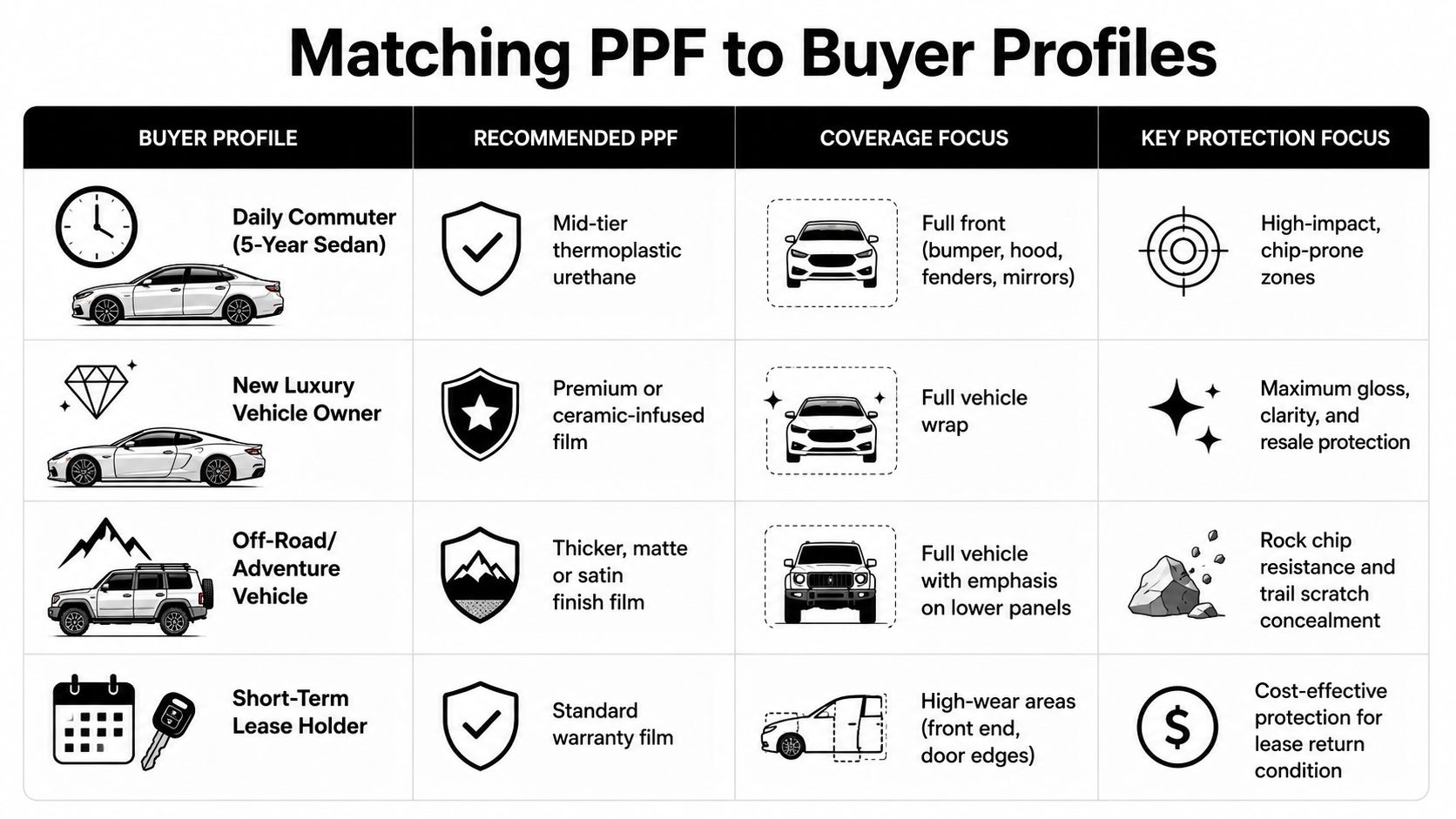
The right package depends on how the vehicle is used, not how impressive the product sheet sounds. A five-year-old sedan driven through town has a different risk profile from a new electric vehicle crossing rural highways every day. Coverage should follow impact zones and ownership plans.
The daily commuter
For a five-year-old sedan, I'd choose a mid-tier TPU film on the full front rather than spend on full-body coverage. Protect the bumper, bonnet, fenders, and mirror caps first. If the paint already has visible chips, discuss touch-up or correction before installation, because film won't make existing damage vanish.
The new luxury or EV owner
A new luxury vehicle or EV deserves premium film where the owner cares about preserving factory clarity and resale presentation. Full-body coverage can make sense when the paint is expensive to replicate or the car will remain in exceptional condition for years. Add a hydrophobic surface treatment only if easier washing and water behaviour justify the extra cost. The coating doesn't replace the film's impact function.
The lease driver
Lease drivers should protect high-wear panels without automatically wrapping every painted surface. A high-gloss film on the front end, door edges, and handle cups can reduce the chance of obvious return-condition damage. Confirm the leasing company's requirements and understand how professional removal will be handled before signing off on the installation.
The track, rural-road, or adventure driver
Frequent gravel, track use, and off-road travel justify broader protection. Consider an 8 mil-class film where impact exposure is severe, plus coverage behind the wheels, along rocker panels, and across the full bonnet. A matte or satin finish can suit an adventure vehicle, but finish preference shouldn't override edge quality or coverage in the areas that get struck.
Match coverage to exposure: spend first on the panels your driving repeatedly places in danger, then add cosmetic coverage if the ownership case supports it.
Why Installation Quality Matters More Than the Film Itself
A premium film installed badly is a disappointing purchase. I've seen otherwise excellent material undermined by lifted edges, trapped dust, visible seams, and overstretched sections around mirrors and bumper corners. Those failures usually come from preparation, handling, pattern selection, or finishing technique, not from the brand printed on the box.
The installer controls the variables that determine whether the film stays invisible. The vehicle needs a clean, controlled environment. The paint must be washed, decontaminated, and inspected under proper lighting. Where necessary, the technician should correct minor defects before the film seals the surface. A plotter-cut pattern matched to the exact vehicle reduces unnecessary knife work and helps maintain consistent panel alignment.
Common installation failures
- Lifted edges: Usually linked to contamination, insufficient cleaning, poor tension control, or inadequate post-installation care.
- Trapped debris: Dust and grit remain visible beneath clear film and can create weak points around the affected area.
- Misaligned patterns: Poor alignment leaves inconsistent seams or exposes more paint than the owner expected.
- Overstretched film: Excessive tension can distort the finish, reduce uniformity, and make difficult curves more likely to release.
- Razor damage: Cutting directly on the vehicle can mark paint or clear coat, even when the cut looks clean at first.
Edge wrapping is one of the clearest differences between a rushed installation and a meticulous one. Wrapping the film around an accessible edge protects the boundary and makes the transition less noticeable. It isn't possible or appropriate on every panel, so the installer should explain which edges will be wrapped, trimmed, or left with a controlled reveal.
Certification protects more than the warranty
Manufacturer certification doesn't guarantee perfect workmanship, but it gives buyers a meaningful standard to verify. Ask whether the technician is certified for the quoted film line, whether the shop uses vehicle-specific plotter patterns, and whether the labour warranty covers lifting and installation defects. A manufacturer warranty is only useful if the installation meets its conditions and the shop will document the work properly.
The installation is the part you live with every day. Film technology matters, but workmanship determines whether that technology remains bonded, clear, and properly aligned through Canadian seasons.
Choosing Professional Installation at Carmedics Autowerks
The workshop should be the centre of your decision. Before choosing a film, ask for a written explanation of the proposed coverage, the exact product line, the film thickness, the edge-finishing method, and the difference between product and labour warranties. A credible installer won't hide those details behind a generic “premium PPF” label.
A professional process should begin with an inspection of the paint. Minor defects may need correction before application, because PPF locks in the condition underneath. The technician should then use a controlled environment, vehicle-specific computer-cut patterns, careful surface preparation, and edge-wrapping techniques where the panel allows. After application, the film needs appropriate cure time before the vehicle is exposed to normal washing and road conditions.
Canadian weather creates additional pressure at the boundaries. Salt, magnesium chloride, repeated wetting, freezing, and thawing can expose weak adhesion or poorly finished edges. That's why local experience matters. A technician who understands winter contamination and wash habits can give more useful maintenance advice than someone who only compares brand catalogues.
Carmedics Autowerks Inc offers PPF installation in Whitby, Ontario, with options including partial bonnet, full bonnet, partial front, full front, and full-vehicle coverage for painted surfaces. You can review the PPF and tint shop in Whitby and use these questions when you speak with any installer:
- Which exact film line is included?
- What thickness is being installed?
- Are the panel edges wrapped or trimmed?
- Is the technician certified by the film manufacturer?
- What does the labour warranty cover?
- What does the product warranty exclude?
- How will existing chips, scratches, or repaired paint be handled?
The best choice protects the investment you've already made in the vehicle. Buy enough coverage for your roads, choose a film with documented performance, and give the installation quality the same attention as the brand.
Carmedics Autowerks Inc offers professional PPF installation in Whitby, including partial-front, full-front, and full-vehicle coverage for drivers who want protection suited to Canadian roads. Visit Carmedics Autowerks Inc to discuss your vehicle, driving conditions, film choice, edge treatment, and warranty requirements before booking.