

Ontario recorded 27,854 fatal and personal-injury collisions in 2024, involving 50,261 drivers and 50,946 vehicles. Those crashes killed 617 people and injured 37,952, according to the province's 2024 preliminary road-safety statistics. Behind every collision is a potential repair cycle, from damage assessment and structural work to refinishing, parts replacement, electronic scans, calibration, and return to service.
That's why auto body collision repair isn't just dent removal. A modern vehicle can look acceptable from the outside while carrying hidden damage to its frame, suspension, wiring, cameras, radar sensors, or restraint systems. The repair must restore how the vehicle performs, not just how it looks.
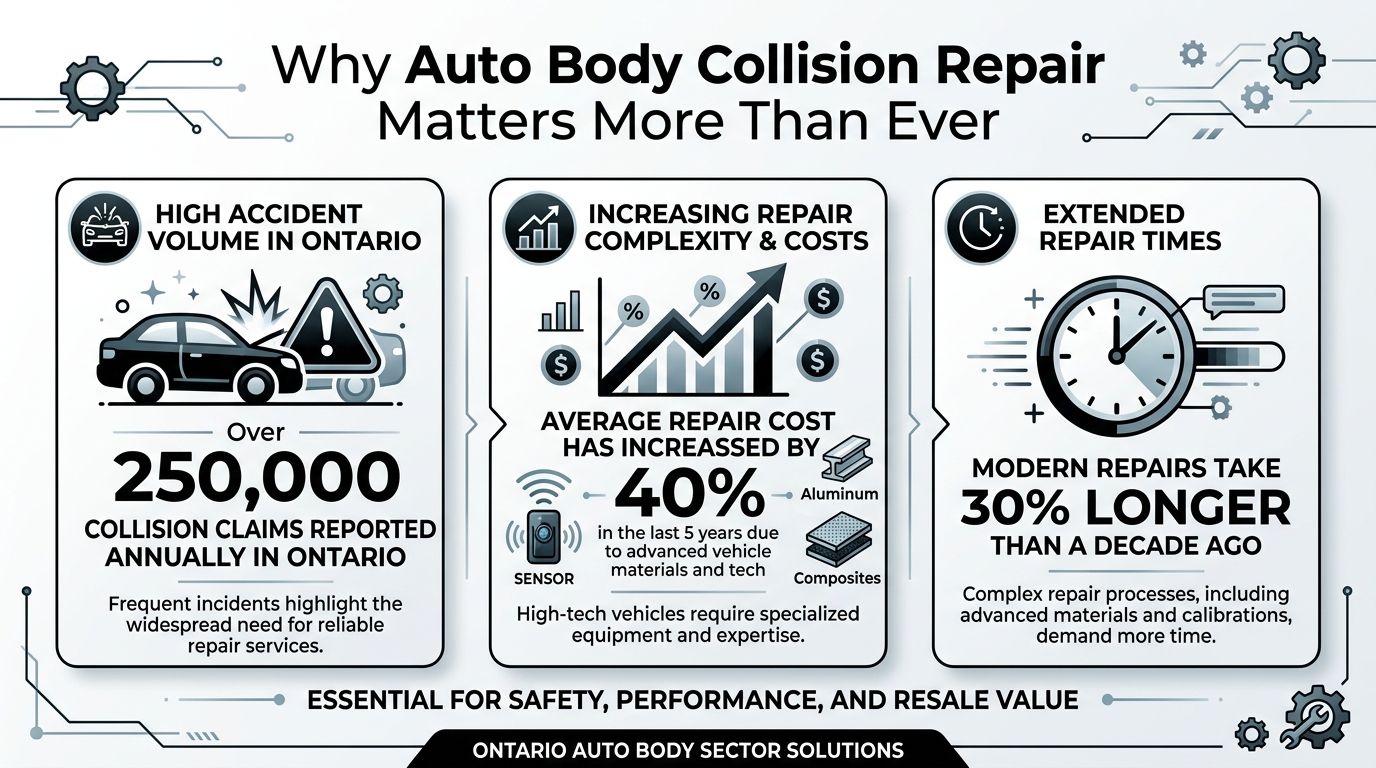
Why Auto Body Collision Repair Matters More Than Ever
Ontario's collision volume creates a recurring demand for competent repair facilities. The province recorded 28,160 fatal and personal-injury collisions in 2023, including 641 deaths and 38,007 injuries, before the 2024 figures remained at a similarly substantial level. The province's Ontario Road Safety Annual Report framework uses police-reported collision records to track fatalities, injuries, collision types, and other road-safety categories over time.
That reporting matters to drivers in Whitby and across the Greater Toronto Area because collision repair demand comes from unavoidable road incidents, not optional cosmetic upgrades. Ontario's earlier reporting also recorded 153,751 total collisions in 2021, including 129,272 property-damage collisions, 23,960 injury collisions, and 519 fatal collisions, as documented in the province's collision data publication. Property-damage crashes make up a much broader repair universe than serious injury events. A vehicle doesn't need to be undriveable to require proper body, suspension, electrical, or sensor work.
A collision repair is a safety process
A professional repair normally addresses several connected systems:
- Structural integrity: Technicians inspect and measure the vehicle's structure before deciding whether frame correction or component replacement is needed.
- Body panels and closures: Bumpers, doors, fenders, hoods, and liftgates must align, latch, seal, and protect occupants as intended.
- Refinishing: Colour matching involves more than applying a similar shade. Preparation, primer, spray technique, blending, and curing all affect the finished result.
- Mechanical and electrical systems: Suspension, steering, lighting, wiring, airbag components, and cooling systems may need inspection after impact.
- Driver-assistance technology: Cameras and radar can require scanning and calibration after parts are removed or mounting geometry changes.
Ontario's repair-and-maintenance market also carries major national weight. Ontario represented 35.1% of Canada's operating revenue in the broader repair-and-maintenance sector in 2023, while Canada's car body shops market was valued at $7.7 billion in 2026, according to the Canadian government market dataset.
Practical rule: Choose a shop based on how it verifies the repair, not how quickly it promises to hide the damage.
A rushed repair can leave uneven panel gaps, poor corrosion protection, incorrect sensor aim, or an unresolved structural issue. The finished vehicle should look right, drive properly, and meet the manufacturer's repair requirements.
The Complete Collision Repair Process Explained
A proper repair starts before anyone removes a bumper. The shop should document the vehicle's condition, record the visible damage, identify warning lights, and check the vehicle identification number so technicians can locate the correct manufacturer procedures.
From estimate to teardown
Damage assessment and documentation establish the starting point. Photographs, scan results, measurements, and the initial estimate help the shop identify visible and probable hidden damage. The first estimate is often not the final repair plan because technicians can't see every damaged component until they disassemble the affected area.
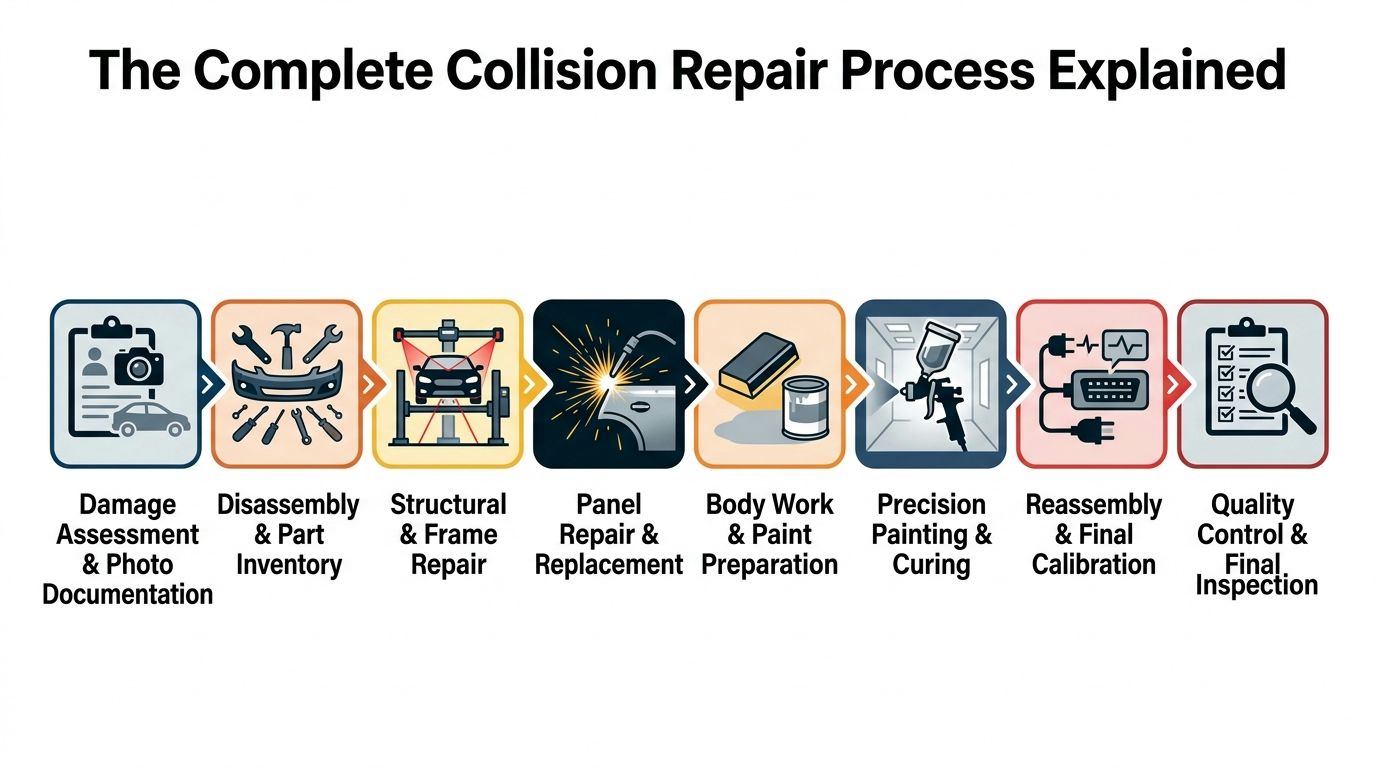
Disassembly and parts inventory reveal what the impact affected. Technicians remove damaged trim, bumper covers, lamps, liners, and other components carefully, then document reusable, repairable, and replacement parts. A shop may find bent brackets, broken mounting points, crushed reinforcement members, or damaged sensor hardware.
Structure comes before cosmetics
If the impact affected the vehicle's structure, technicians use dedicated measuring equipment to compare the vehicle against factory dimensions. Frame correction is not a matter of pulling metal until the panels fit. The shop must control the repair sequence, measure progress, and confirm that mounting points return to the required position.
Panel decisions follow the manufacturer's procedures and the damage itself. A technician may repair a panel when its shape and material allow it, or replace it when the damage affects strength, corrosion protection, mounting points, or finish quality. The cheapest visible option isn't always the correct repair.
Refinishing, reassembly, and verification
Body preparation includes straightening, sanding, corrosion protection, primer, and masking. Paint technicians then match the colour and texture, blend adjacent panels where required, and cure the finish in a controlled environment.
Reassembly is where overlooked problems often surface. Technicians reconnect wiring, install trim, verify lamps, check door and hood operation, confirm wheel alignment where applicable, and complete required diagnostic scans or calibrations.
Ask for this before delivery: confirmation that the shop completed the required scans, calibrations, alignment checks, and final inspection, not merely that the vehicle passed a visual review.
Quality control should include a road test when appropriate, examination of panel gaps and paint, function checks for safety systems, and a review of the completed repair against the estimate and manufacturer information. If a shop can't explain those steps, you're entitled to question whether the repair was completed thoroughly.
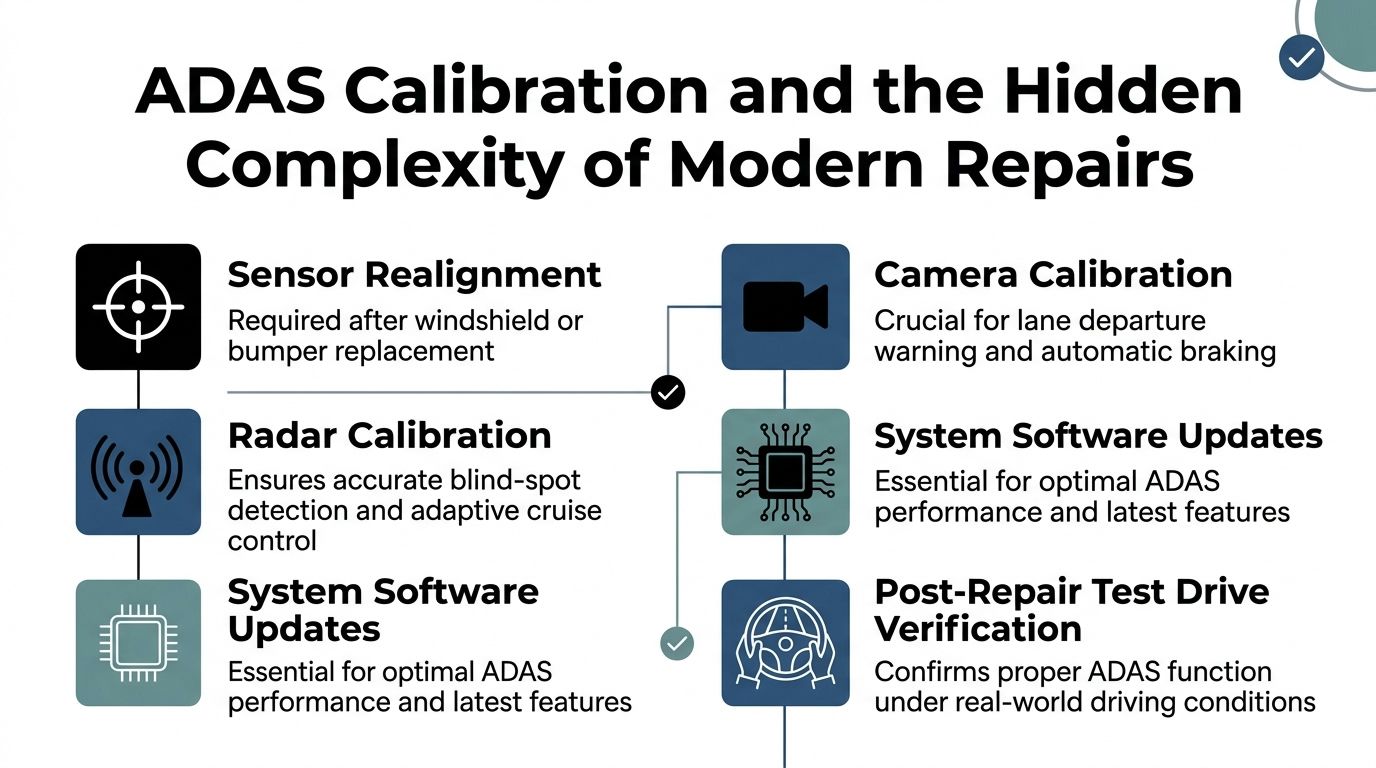
ADAS Calibration and the Hidden Complexity of Modern Repairs
A bumper can be cosmetic in appearance and technical in function. Many vehicles hide radar units, cameras, wiring, and mounting brackets behind or around body panels. If an impact shifts the bracket, changes ride height, alters wheel alignment, or disturbs the sensor's field of view, the vehicle may need calibration even when the car remains drivable.
The requirement must be determined by VIN and manufacturer service information, not by a generic assumption that a particular repair is always safe without calibration. The I-CAR calibration-requirement search process helps identify manufacturer-specific requirements and common calibration triggers.
Common calibration triggers
A shop should investigate calibration requirements after work such as:
- Windshield replacement: Forward-facing cameras may be mounted near the glass and require recalibration after replacement.
- Bumper removal or installation: Radar sensors and their brackets can sit behind bumper covers.
- Front-end structural repair: Even small changes in mounting geometry can affect sensor aim.
- Suspension work: Ride height and steering geometry influence the vehicle's relationship with the road.
- Wheel-alignment changes: A repaired vehicle may need alignment verification before calibration.
- Disturbed sensor mounting locations: A bracket, radar unit, camera, or connector can be affected without obvious exterior damage.
Static and dynamic calibration are different jobs
Static calibration uses a controlled shop environment, approved targets, precise measurements, and manufacturer-specific software. The vehicle must sit on a suitable surface, with the correct target placement and sufficient space.
Dynamic calibration uses a road procedure in which the vehicle observes defined conditions while the system learns or verifies its operating parameters. Some vehicles require one method, some require both, and the answer depends on the manufacturer and system.
I-CAR Canada training listings in Ontario cover static and dynamic calibration for forward-facing cameras, front radars, rear radars, and infrared-based ADAS sensors. The AIA Canada guidance referenced through I-CAR's calibration resources also identifies the facility, targets, kits, software, wheel-alignment capability, and trained electronics personnel needed for in-house work.
A shop shouldn't claim that a scan alone proves calibration. A diagnostic scan can identify faults and system status, but it doesn't automatically correct sensor aim. Ask whether the shop identified the affected ADAS systems, checked the mounting geometry, followed the OEM procedure, and completed post-repair verification.
If the facility lacks the space, targets, software, alignment equipment, or trained staff, subletting calibration to a qualified specialist is often the responsible choice. Keeping every operation in-house matters less than controlling the quality of the result.
Collision Repair Costs and the EV Factor
The final repair cost reflects more than dents and labour hours. Estimates can include structural measurement, frame correction, body labour, paint preparation, refinishing materials, replacement parts, mechanical work, diagnostic scans, ADAS calibration, wheel alignment, and corrosion protection.
OEM and aftermarket parts can affect both price and procedure. The correct choice depends on the vehicle, the damaged component, insurer requirements, manufacturer instructions, and the effect on safety systems. A cheaper part isn't a bargain if it creates fitment problems, interferes with a radar sensor, or produces a finish that needs rework.
Electric vehicles add another layer. Battery protection, high-voltage safety procedures, specialised components, software, and sensor integration can change the repair decision. Canadian data show that BEV repairable severity reached $6,645 in Q2 2026, compared with $5,411 for ICE vehicles, a $1,234 gap, according to Canadian Auto Dealer's reporting on EV repair costs.
Collision Repair Cost Comparison by Vehicle Type
| Vehicle Type | Average Repairable Severity (Q2 2026) | Cost Gap |
|---|---|---|
| Battery electric vehicle | $6,645 | $1,234 higher than ICE |
| Internal-combustion vehicle | $5,411 | Baseline |
The gap doesn't mean every EV claim becomes a total loss, and it doesn't mean every gasoline vehicle is inexpensive to repair. Total-loss decisions depend on the vehicle's value, the approved repair plan, structural and battery findings, parts availability, and insurer evaluation.
For new-car owners, the important question isn't just “How much is the bumper?” Ask whether the bumper contains radar hardware, whether a bracket is replaceable, whether the vehicle needs software or calibration, and whether the proposed parts meet the manufacturer's requirements.
My recommendation: Don't approve an estimate by comparing only the visible parts list. Compare the complete repair plan, including scans, calibration, alignment, structural verification, and the parts specification.
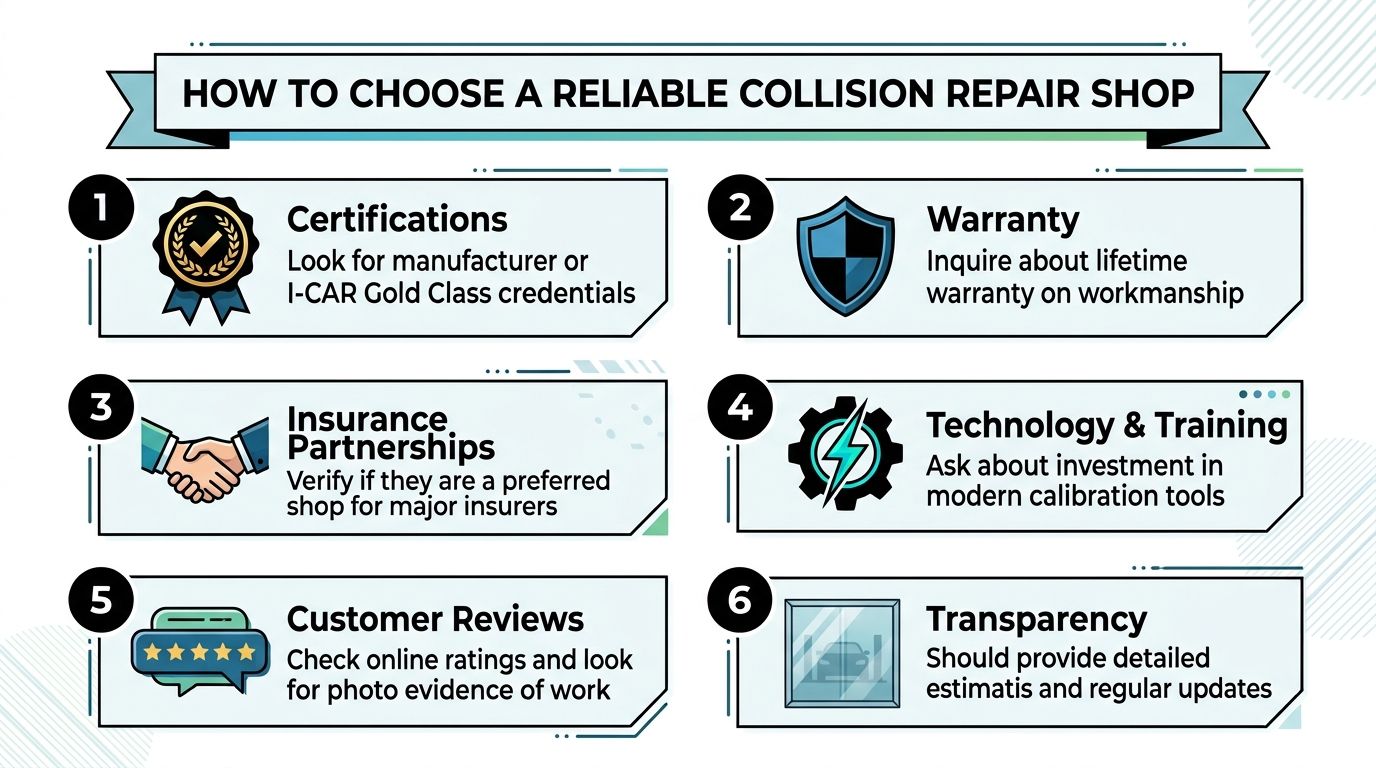
How to Choose a Reliable Collision Repair Shop
Price matters, but it shouldn't be your first filter. A low estimate can omit teardown, scans, calibration, structural measurement, or necessary replacement operations. Those omissions may appear attractive until the shop discovers hidden damage or returns a vehicle with unresolved safety-system faults.
Start by asking how the facility handles manufacturer procedures. A reputable shop should be willing to explain how it identifies OEM requirements by VIN and how it documents deviations, approvals, and supplements.
Questions that separate a proper shop from a rushed one
- Training: Ask whether technicians have relevant I-CAR training and whether the shop keeps current with modern vehicle construction and ADAS systems.
- Structure: Confirm that the facility can perform proper structural measurement and frame correction, or explain where it sends that work.
- Calibration: Ask which static and dynamic calibration services it performs, what equipment it uses, and when it sublets the work.
- Paint quality: Look for a controlled spray booth, proper colour matching, blending expertise, and a clear refinishing warranty.
- Documentation: Request a written estimate that identifies parts, labour, scans, calibration, alignment, and supplements.
- Warranty: Read the workmanship warranty. Find out what it covers, for how long, and whether exclusions apply.
Red flags deserve a hard response
Be cautious if a shop dismisses scanning because the warning lights are off, treats calibration as unnecessary without checking the VIN, refuses to discuss OEM procedures, or quotes far below other detailed estimates without explaining why. A facility that only talks about appearance may not be evaluating the vehicle's structure and electronics properly.
Insurance partnerships can help with administration, but a preferred relationship shouldn't replace your questions. You still need to know who controls the repair plan, how supplements are handled, which parts are proposed, and whether you can review the completed documentation.
Carmedics Autowerks Inc is one Whitby option for drivers seeking collision repair alongside general auto repairs, fleet maintenance, window tinting, and paint protection film installation. Those additional services don't replace the evaluation criteria above. Use the same questions for any shop, and choose the facility that gives clear technical answers.
Understanding Repair Timelines and Common Delays
A drivable vehicle can still wait weeks because driving ability doesn't prove repair readiness. A cracked bumper, damaged sensor bracket, missing camera, or unavailable lamp may leave the vehicle mobile while preventing safe final reassembly.
The most common bottleneck is parts availability, not bodywork time. Canadian collision repair reporting identifies parts shortages and technician shortages as continuing problems, and a 2026 Canadian collision-industry report says repair timelines can run about 10 days longer than normal, with smaller communities facing even slower access.
What happens during a long repair
A typical delay can unfold like this:
- The shop disassembles the vehicle: Hidden damage changes the original estimate.
- The insurer reviews a supplement: The repair can't proceed until additional work receives approval.
- The shop orders parts: One unavailable bumper, bracket, lamp, sensor, or trim piece can hold up reassembly.
- The technician schedules the work: Skilled staff may be managing several complex repairs.
- Calibration waits for a complete vehicle: Calibration may require correct ride height, alignment, parts, battery condition, and a controlled environment.
- Final inspection identifies a correction: A paint, fitment, scan, or road-test issue must be fixed before delivery.
Don't accept silence as a timeline. Ask the shop which parts are on order, which approvals are outstanding, whether the vehicle is waiting for a specialist, and what work can proceed safely while they wait.
The useful question isn't “Why isn't it finished?” Ask “What exact item or approval is stopping the next repair operation?”
Insurers also need clear updates when delays affect rental arrangements or transportation plans. A shop can't manufacture a missing part, but it can communicate the constraint, document it, and explain the next milestone. That transparency makes a frustrating wait manageable and helps prevent pressure to return an incomplete vehicle.
Why Whitby Drivers Choose Carmedics Autowerks for Collision Repair
A collision shop in Whitby should be judged against the technical standards that matter after modern crashes. That means a documented assessment, a repair plan that accounts for hidden damage, structural verification when required, quality refinishing, and proper attention to scans and ADAS calibration.
Carmedics Autowerks offers collision repair for drivers who need the vehicle's structure and finish restored after damage. Its broader service range includes general auto repairs, fleet maintenance, window tinting, and paint protection film installation, which can be useful for owners who want one local facility for both repair and vehicle protection needs.
A local repair decision should remain technical
The right questions are straightforward. Can the shop explain how it assesses structural damage? Does it identify sensor and camera concerns before reassembly? Can it coordinate calibration when the work requires equipment or procedures outside its facility? Will the team explain parts decisions, supplements, paint matching, and final checks?
For car enthusiasts and new-vehicle owners, finish quality matters, but it isn't enough. A straight panel with poor alignment, an incorrect paint blend, or an uncalibrated driver-assistance system isn't a complete repair. The shop should return a vehicle that looks correct and functions as the manufacturer intended.
That's the standard I'd use for any collision claim in Whitby. Review the estimate, ask for the technical steps, keep communication in writing, and don't let a quick cosmetic fix substitute for a verified repair.
Carmedics Autowerks Inc offers collision repair, general auto repairs, fleet maintenance, window tinting, and paint protection film installation for Whitby drivers. For a proper assessment of structural, cosmetic, and technology-related collision damage, visit Carmedics Autowerks Inc and arrange a conversation about your vehicle's repair needs.