

The popular advice says you must choose between paint protection film or ceramic coating. That's the wrong question for a Whitby car. Ontario winters throw salt brine, sand, and gravel at the front end, while summer adds UV exposure, bugs, and chemical contamination. A hydrophobic coating can make a vehicle easier to wash, but it won't absorb a stone kicked up on Highway 401.
PPF and ceramic coating aren't interchangeable. PPF protects against physical impact, while ceramic coating improves resistance to contamination, water spotting, and wash-related grime. For many daily-driven cars, the sensible answer isn't one product over the other. It's targeted PPF where debris strikes, followed by ceramic protection where easy maintenance matters.
| Driving priority | Better first choice | Why |
|---|---|---|
| Stone chips and gravel | PPF | Creates a sacrificial physical barrier |
| Salt, bugs, and easier washing | Ceramic coating | Helps contaminants release from the surface |
| Long-term ownership | Both | Covers impact and chemical exposure |
| Short lease or appearance-focused ownership | Ceramic coating or partial PPF | Matches the ownership horizon and budget |
The rest of this guide breaks down the materials, compares the criteria that matter, explains Whitby-area pricing factors, and matches each option to real driving habits. It also covers when ceramic over PPF makes sense and what to request from a Whitby paint protection specialist. I won't declare a universal winner because a Whitby winter punishes paint differently than a California driveway.
Why Whitby Drivers Should Stop Treating PPF and Ceramic as Either Or
A Whitby vehicle doesn't face one type of damage. From December through March, salt brine works into seams and sits on lower panels. Highway 401 commuting adds gravel and road debris to the bonnet, bumper, mirrors, and front fenders. Then summer lake runs bring strong sunlight, bug residue, tree contamination, and repeated washing.
That damage profile makes the either-or comparison misleading. Ceramic coating can't physically stop a stone chip, and PPF doesn't provide the same water-shedding behaviour or wash convenience as a dedicated ceramic layer. Each product solves a different problem, so the right choice starts with the threat that bothers you most.
The practical rule: If your first concern is a chip in the bonnet, start with PPF. If your first concern is cleaning salt and bugs from the entire vehicle, start with ceramic coating.
Whitby drivers also need to think about where they drive and how long they keep the vehicle. A new SUV commuting daily through Durham Region needs a different plan from a weekend sports car that stays indoors. A leased vehicle returning in a few years has a different financial calculation from a car you intend to keep through several Ontario winters.
The winter damage test
Ask yourself three direct questions:
- Where does the car spend its kilometres? Highway mileage raises the risk of front-end impact damage.
- Where does it spend its nights? Outdoor parking increases exposure to contamination and temperature changes.
- How long will you own it? A longer ownership horizon makes durable surface protection easier to justify.
Canadian demand for PPF is established and projected to keep expanding. One Canada PPF market forecast values the market at USD 35.6 million in 2025, with a projection of USD 45 million by 2030, implying a 4.8% CAGR over that period. A separate outlook estimates USD 31.4 million in 2024 and USD 43.6 million by 2030, with a 5.9% CAGR from 2025 to 2030.
That growth doesn't mean every driver needs full-body film. It does show that PPF has moved well beyond a novelty accessory. The useful decision is more specific: match coverage to the panels that take the abuse, then add ceramic protection when chemical resistance and easier washing justify it.
What Paint Protection Film and Ceramic Coating Are
Each product physically interacts with paint differently, and that difference determines which one addresses your primary threat.
Paint protection film is a clear urethane sheet installed over painted panels. It absorbs and disperses the force of small impacts before they reach the factory paint. Quality film can also self-heal minor surface marks when exposed to suitable heat, reducing light wash marring.
PPF is installed panel by panel. The installer cleans and prepares the paint, positions the film, works out installation fluid and air, then trims it or follows a computer-cut pattern around the panel. The film is removable, so it can be replaced later without treating it like permanent paint.
PPF coverage has levels
A partial-front package can cover the most exposed section of the bonnet and bumper. A full-front package generally extends across the front bumper, bonnet, fenders, and mirrors, depending on the vehicle and package. Track-oriented coverage can add rocker panels and other impact zones, while full-body PPF protects nearly every painted surface.
PPF also has a genuine engineering history. This history of PPF traces its roots to the Vietnam War era, when 3M developed urethane film to protect helicopter rotor blades from debris. The material later appeared on military aircraft and race cars before moving into consumer vehicles. PPF began as a debris-protection solution, not a cosmetic trend.
Ceramic coating is a liquid polymer applied to prepared paint. Professional systems commonly use silicon dioxide or silicon carbide chemistry and form a bonded surface layer over the clear coat. The cured coating does not absorb a gravel strike. It improves resistance to water, contamination, UV exposure, and chemical staining while making routine washing easier. Carmedics Autowerks' ceramic coating guide for cars explains how these systems differ.
Ceramic systems vary considerably
Consumer products, professional coatings, and accredited installer systems are not equivalent. Professional lines may be offered with different durability tiers, including 1-year, 5-year, and 9-year warrantied systems, depending on the product and installation requirements. The warranty is tied to preparation, application, maintenance, and inspection conditions, not the bottle label.
The choice is direct. If your priority is reducing rock-chip risk, ceramic alone is the wrong tool. If you want the whole vehicle to release salt film, bug residue, and road grime more easily, ceramic adds a benefit that bare PPF does not provide. Carmedics Autowerks offers both PPF installation and professional ceramic coating, and an in-person inspection shows how each finish looks on an actual vehicle.
For technical benchmarks, ORAFOL's ORAGUARD 2815GF+ data sheet identifies a transparent polyurethane film with a hydrophobic topcoat and self-healing properties. It also lists a xenon-arc ageing result of more than 4,500 kJ / 3,400 hours to SAE J2527 and a pass result for SAE J400 gravel resistance in the ORAGUARD 2815GF+ technical data sheet. Those documented performance details are more useful than vague labels such as “premium” or “lifetime.”
Head to Head Comparison Across the Criteria That Matter
PPF and ceramic coating solve different Whitby winter problems. Compare them by the damage, cleaning burden, and repair options your vehicle faces.
| Criterion | Paint Protection Film | Ceramic Coating |
|---|---|---|
| Stone-chip protection | Strongest option. Absorbs many small impacts on covered panels | Does not stop rock chips |
| Chemical and salt resistance | Shields covered paint from many contaminants, but still needs cleaning | Resists contamination and helps grime release during washing |
| UV and oxidation defence | Protective topcoat technology varies by product | Helps shield and preserve the clear coat |
| Hydrophobic behaviour | Varies by film and topcoat, usually less pronounced than ceramic | Core benefit, with strong water-shedding behaviour |
| Easy-clean performance | Adds protection, though winter grime can remain on the surface | Usually the easier surface to wash |
| Gloss and finish | Preserves the existing appearance; gloss depends on film | Adds slickness, gloss, and visual depth |
| Self-healing | Can reduce minor surface marks with heat, depending on film | Does not self-heal impact damage |
| Repairability | Damaged sections can often be replaced without refinishing the whole panel | Cannot repair a chip or scratch; damaged paint must be corrected first |
| Ontario longevity | Product and care determine service life | Product and care determine service life |
| Maintenance effort | Needs careful washing and edge inspections | Needs careful washing and the specified maintenance routine |
| Typical cost band | Higher as coverage expands or panels become more complex | Lower than full-body PPF, but correction and product tier affect cost |
| Warranty handling | Follow film manufacturer and installer terms | Follow coating manufacturer and installer maintenance terms |
The table's repairability row matters in real use. A stone strike on a protected bumper may call for a local film replacement. The surrounding paint can remain untouched. A ceramic coating has no comparable field touch-up for impact damage. It protects the finish from contamination, not from the force of gravel.
3M Canada describes Scotchgard Pro Series films as protecting against stone chips, scratches, bug damage, road tar stains, automotive fluid stains, and harsh ultraviolet radiation on its paint-protection-film product pages. Those hazards match the front-end abuse seen on Canadian daily drivers. PPF remains the clear choice for bonnet, bumper, mirror, and other impact zones exposed to highway spray and winter grit.
Ceramic coating wins on the cleaning side. After salt, slush, and bug residue build up, a coated surface generally lets water and grime release more readily during washing. It also helps with chemical contamination and UV exposure across panels without film. That convenience covers the whole vehicle, while PPF concentrates protection where impacts happen.
Choose by the problem you want solved first
A daily highway commuter should start with front-end PPF. Frequent gravel roads, new paint, or a strong dislike of stone chips all support that choice. Add ceramic coating when easier washing, gloss, and broader chemical resistance matter across the rest of the vehicle.
A town-focused SUV with limited highway exposure can reasonably start with ceramic coating. It will not stop a chip, but it makes salt film and road grime easier to manage. Owners who want both outcomes should protect impact zones with PPF, then coat the remaining paint. That layered approach fits Whitby conditions better than treating the products as equal substitutes.
For a fuller review of film's trade-offs, read this PPF advantages and disadvantages guide. Then choose coverage according to your routes, parking, and tolerance for visible front-end wear.
Cost in Whitby and What Really Drives the Price
A low quote can hide low coverage. Shops often use “front PPF” for very different packages, from a small bonnet section to the bonnet, bumper, fenders, and mirrors. Ask for every covered panel in writing before comparing prices. The products are layered solutions, so price should follow the damage each one is meant to prevent, not a simple either-or package.
These are practical 2026 Whitby-area budgeting bands, not verified market statistics. Vehicle size, paint condition, film selection, coverage, and installer workload can all change the final price.
| Coverage package | Price range in CAD | Best for |
|---|---|---|
| Partial-front PPF | CAD 600 to CAD 1,200 | Owners targeting the most exposed front sections |
| Full-front PPF | CAD 1,500 to CAD 3,000 | Highway commuters and new vehicles |
| Full-body PPF | CAD 5,000 to CAD 10,000 | High-value vehicles and long-term preservation |
| Professional-grade ceramic coating | CAD 900 to CAD 2,500 | Whole-vehicle chemical protection and easier maintenance |
Why two quotes can look far apart
Film thickness and brand tier affect material cost, installation technique, and available patterns. XPEL, 3M, and SunTek products can differ in finish, topcoat characteristics, pattern selection, and warranty terms. Computer-cut patterns limit unnecessary cutting on the vehicle. Bulk installation can provide more wrap and edge coverage, but only when the installer has the skill and time to finish it cleanly.
Vehicle design changes the labour involved. A compact sedan with simple bonnet lines is a different job from a large SUV with complex fenders, sensors, grille openings, sharp creases, and difficult mirror shapes. Full-body PPF adds preparation and installation time because every painted panel needs inspection, cleaning, alignment, and finishing. Review this PPF cost guide before requesting quotes, so you can compare coverage rather than just the total.
Ceramic coating prices usually depend heavily on paint correction, not only the coating chemistry. A new vehicle may need light decontamination and preparation. A used daily driver may need several correction stages before the coating can preserve the finish. Ask which correction work is included, which coating line will be applied, and what maintenance the warranty requires.
Mobile installation may cost less because the operator carries less shop overhead. That does not automatically mean poor workmanship, but a controlled, clean bay gives better conditions for film alignment, adhesive work, and coating curing. Whitby humidity, dust, temperature changes, and winter scheduling all affect the process.
The cheapest quote becomes expensive when an edge lifts, contamination gets trapped, or the coating needs correction early. Buy the documented process and stated coverage, not the shortest number on the page.
Which Option Fits Your Vehicle and Driving Habits
The right product changes with the driver. A new commuter, a weekend sports-car owner, a lease customer, and a delivery fleet all expose paint to different risks.
The new sedan commuting on the 401
Choose full-front PPF as the first investment. The bonnet, front bumper, fenders, and mirrors face repeated debris exposure, and a daily 401 commute gives chips more opportunities to appear. Add ceramic coating to the uncovered body if you want easier washing and broader chemical protection.
This driver benefits from preserving factory paint early. Correcting existing chips later won't recreate the original finish, while film installed before the damage begins gives the front end a sacrificial layer.
The sports car in a heated garage
Choose full-front or extended-front PPF, then consider ceramic over the rest of the vehicle. Garage storage reduces some exposure, but weekend driving can still put the nose into gravel, bugs, and road debris. On a sports car, visible finish quality matters, so ask for a clean pattern strategy and edge treatment.
If the car sees very little highway use, full-body film may be unnecessary. Protect the impact zones first, then use ceramic to simplify cleaning and maintain gloss.
The SUV leased until 2028
Choose a targeted partial-front PPF package if the lease return condition is your primary concern. It can address the most exposed painted sections without committing to full-body coverage on a vehicle you don't own long term. Ceramic coating may make sense when appearance and wash convenience matter more than chip prevention.
Check lease terms and installer warranty language before booking. The goal isn't to purchase every available layer. It's to reduce avoidable cosmetic damage while matching the remaining ownership period.
The delivery fleet operating through Ajax and Oshawa
For fleet SUVs, choose impact-focused PPF on the front bumper, bonnet leading edge, mirrors, and other repeatedly exposed areas. Ceramic coating across every vehicle can make washing easier, but it won't solve the damage caused by highway debris or frequent route driving.
The one situation where neither product alone is enough is a high-mileage fleet vehicle that faces both severe impacts and constant contamination. That vehicle needs targeted PPF plus a practical ceramic maintenance plan, along with consistent washing and inspection. Neither coating nor film replaces sensible parking, safe following distances, or prompt removal of salt and bug residue.
Can You Stack Ceramic Coating Over PPF
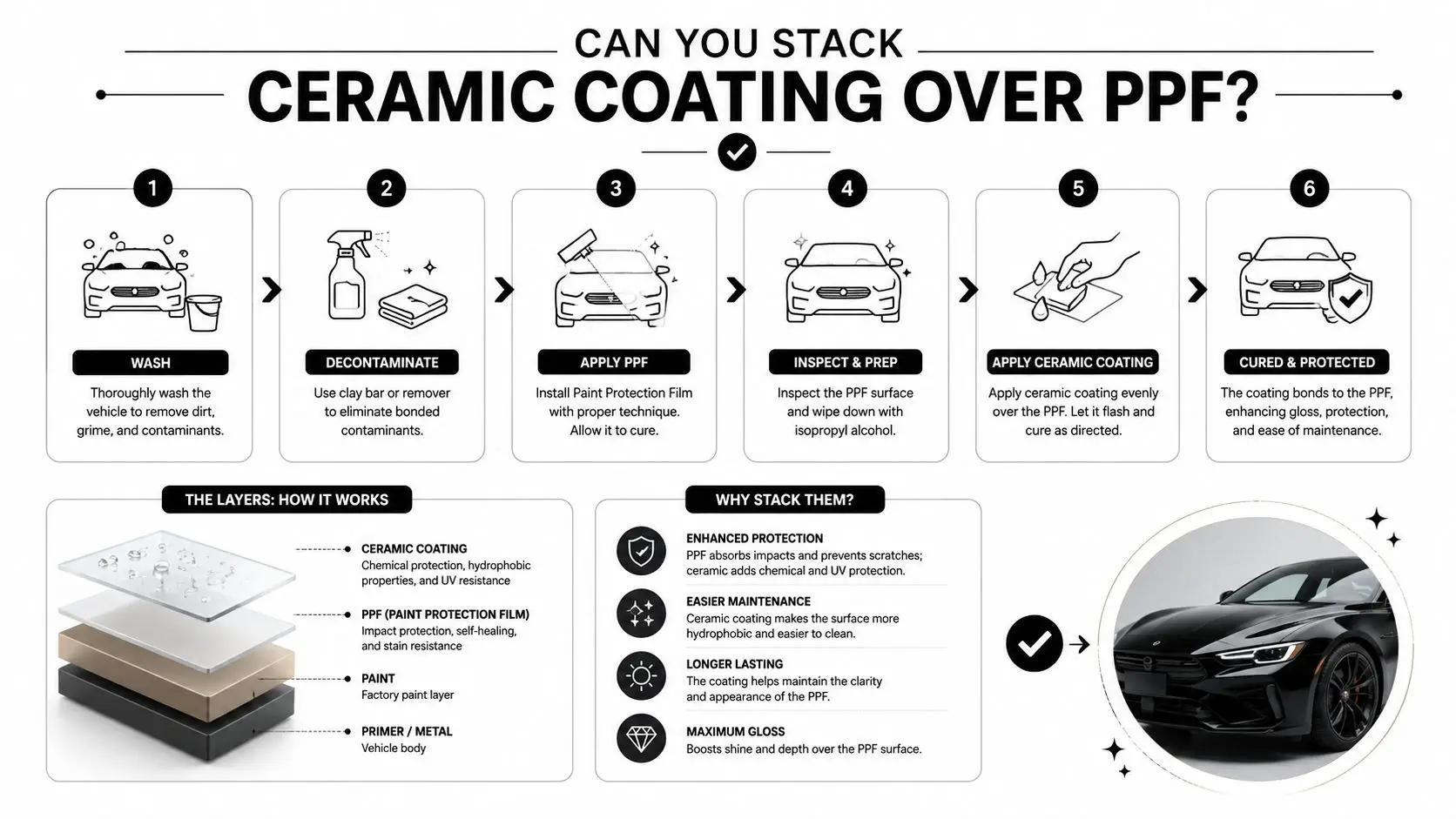
Yes, and for many Whitby vehicles it is the most complete setup. Install PPF first on the impact zones, allow the film and adhesive to settle according to the installer and manufacturer requirements, then apply a film-safe ceramic coating over the PPF and the remaining painted surfaces.
The sequence matters. PPF needs a properly prepared surface and clean installation. Ceramic coating then adds water-shedding behaviour, chemical resistance, and easier winter washing over the film itself. It can also protect the uncovered paint, so the vehicle gets two different forms of defence rather than one product being asked to do both jobs.
When the topper earns its place
Layering makes the most sense for a new vehicle kept long term, a high-value car, or a daily driver that sees both highway debris and repeated winter contamination. Canadian guidance on ceramic coating over PPF makes the product distinction clear: PPF handles impact protection, while ceramic improves chemical resistance and cleaning.
Budget builds don't always need the second layer. Skip the ceramic topper if the vehicle has limited ownership ahead, the owner is comfortable washing untreated film carefully, or the chosen finish and manufacturer instructions don't support the proposed coating. Matte and satin films also require product-specific advice because the wrong coating can alter the intended appearance.
The added cost depends on the amount of PPF, the coating tier, paint correction, and whether the vehicle is already prepared for the second installation. Don't accept a generic promise that every ceramic product bonds equally well to every film. Ask these questions first:
- Compatibility: Is the coating approved or recommended for the exact PPF brand and finish?
- Timing: How long must the film settle before coating application?
- Warranty: Does the film warranty remain intact after the ceramic topper is installed?
- Maintenance: Which wash products and inspection schedule does the coating require?
- Coverage: Is the topper applied only to PPF or to the entire exterior?
A shop that can't answer those questions clearly hasn't given you a complete layered-protection plan.
The Right Choice for Your Car and When to Book It
Book PPF or ceramic coating in late spring or early summer, when stable warm conditions make preparation, installation, and curing easier to manage. Waiting until salt and slush season means asking a fresh installation to begin its life in the least forgiving part of the year.
Use this decision rule:
- Choose PPF for highway impact protection, new vehicles, and cars where resale condition matters.
- Choose ceramic coating for drivers who prioritise easier washing, gloss, and chemical resistance across the whole vehicle.
- Choose both when you're keeping the car long term in Whitby and want protection from both debris and contamination.
Request a written quote that specifies the exact coverage by panel or measurement, film brand and thickness, ceramic product line, correction stages, warranty terms, and cure-time instructions. The installer should inspect the existing paint before recommending a package, especially on used vehicles with chips, scratches, repainted panels, or failed previous coatings.
Contact Carmedics Autowerks for an in-person inspection rather than selecting a default package online. The right answer depends on your car's paint condition, commuting route, parking situation, and ownership plan.
Carmedics Autowerks Inc offers PPF installation, professional ceramic coating, paint correction, and related vehicle protection for Whitby cars and SUVs. Visit Carmedics Autowerks Inc to arrange an inspection and get a quote built around the panels your Ontario driving exposes.